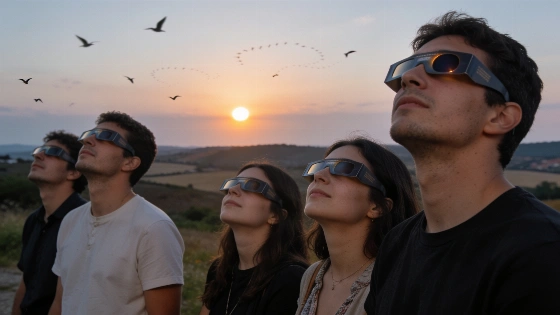
A total solar eclipse will cross northern Spain on August 12, 2026. Temperatures are set to drop and birds may react as daylight fades. The event will be visible as partial in the south and Canary Islands.
On August 12, 2026, Spain will witness a total solar eclipse, a phenomenon not seen in the country for over a century. The path of totality will begin in Galicia and sweep southeast across the northern peninsula, reaching Castellón and the Balearic Islands. In these areas, the Moon will completely obscure the Sun just before sunset, while the rest of Spain, including the south and the Canary Islands, will experience only a partial eclipse.
Pedro Duque, astronaut and president of HispaSat, has outlined what residents can expect as the eclipse unfolds. According to his explanation, the event will start around 19:20, with totality arriving near 20:30. As the Moon gradually covers the Sun, daylight will dim and the landscape will take on an unusual appearance. Duque notes that the temperature will drop and colors will fade, creating a rare atmospheric effect. The sudden darkness may also disrupt animal routines, particularly among birds, which could interpret the fading light as nightfall and seek shelter earlier than usual.
One of the most anticipated moments will occur just before totality, when the so-called 'diamond ring' effect appears. This brief flash happens as the last rays of sunlight pass through lunar valleys, producing bright points of light around the Moon's edge. Duque emphasizes the importance of using certified eclipse glasses throughout all partial phases, including during the diamond ring, as regular sunglasses do not provide adequate protection. Only during the brief period of totality, when the Sun is fully covered and the solar corona becomes visible, is it safe to remove protective eyewear.
Observers are advised to choose locations with a clear view to the west, as the Sun will be low on the horizon during the event. The eclipse's rarity is underscored by the fact that Spain will experience three total solar eclipses in quick succession—2026, 2027, and 2028—after more than a century without one. This sequence is a result of the complex mechanics of celestial orbits, which, while predictable, rarely align to produce total eclipses over the same region.
For those interested in how weather patterns can shift rapidly in Spain, a recent report on sudden temperature drops and rain in Bizkaia highlights how quickly atmospheric conditions can change, a factor that may also influence eclipse viewing experiences.
As the date approaches, local authorities and scientific organizations are expected to provide further guidance on safe viewing practices and the best observation points. The event is likely to attract significant public interest, offering a rare opportunity for both scientific observation and communal experience across much of northern Spain.
Total solar eclipses are among the most striking astronomical events visible from Earth. They not only transform the sky but also offer a unique chance to observe the Sun's corona, which is usually hidden by the solar disk. The next opportunity for such an event in Spain after this series may not occur for many decades, making the 2026 eclipse a significant occasion for residents and visitors alike.