Most Spanish workers still drive to work, clogging roads and filling parking lots. A new law now forces large companies to make real mobility plans, but real alternatives are still hard to find.
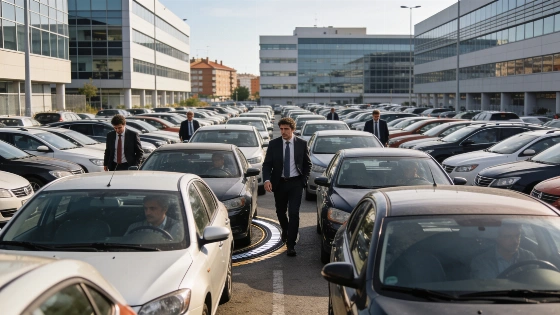
Every weekday, Spain’s roads jam up with millions of commuters. Most are behind the wheel, inching through traffic, circling for parking, and often running late. The numbers are clear: 62.1% of Spanish workers drive to work, according to the Censo de Movilidad 2021 from the Instituto Nacional de Estadística (INE). This isn’t just about distance. As offices and factories moved to the edges of cities, public transport didn’t keep up. For many, the car is the only real option.
This leads to daily gridlock. Industrial parks and business zones fill up fast. Parking runs out long before everyone arrives. In one case, an office with 80 parking spots has to serve 150 employees. Most end up searching for space outside. Big cities like Madrid, Barcelona, Valencia, Sevilla, and Málaga see the worst of it. Municipal data shows just how many people travel for work every day.
In Galicia, 69.5% of employed people commute to work by car or motorcycle, highlighting that car dependency is not just an issue for Spain's largest cities.
The cost of this car-first system goes far beyond wasted time. A Michael Page survey says the average Spanish commute is 36 minutes door to door. For many, it’s much longer. About 1.2 million people travel up to 40 kilometers each morning, often crawling along—60% of that time at just 20 km/h. For them, the trip can stretch past ninety minutes. Public transport doesn’t always help. Forty percent of users call their commute stressful, blaming unreliable service and frequent delays, especially when the weather turns bad.
The wider impact is everywhere. Reports from the Dirección General de Tráfico (DGT) and the Instituto para la Diversificación y Ahorro de la Energía (IDAE) spell it out: dirtier air, more CO2, more noise, more crashes, and a more sedentary life. Everyone pays the price, not just drivers.
Law forces a shift
According to recent Spanish legislation, companies with more than 200 employees or over 100 per shift are now required to develop a Sustainable Mobility Plan for work commutes, with a deadline set for December 5, 2026. This regulatory move aims to prioritize walking, cycling, and public transport as alternatives to private car use, and obliges firms to coordinate these measures with employee representatives.
Until now, only a few companies bothered with mobility plans. That changes with the new Ley de Movilidad Sostenible. Article 26 makes it mandatory for workplaces with 200 or more employees—or 100 per shift—to set up a Sustainable Mobility Plan. This isn’t just paperwork. The law calls for a real strategy, covering infrastructure, parking, public transport, cycling, and ways to combine them. But without real alternatives to the car, these plans could end up as empty promises.
Some regions are trying new things. Castilla y León’s BUSCyL card gives all residents free public bus rides, covering more than 2,600 routes and 243 concessions. The xCuenca project links outlying towns to the city and high-speed rail with on-demand buses, paid for by the government’s recovery plan. But these are rare. Most of Spain still runs on cars.
Contradictions and setbacks
Even as new ideas appear, old habits stick. The national plan for bus concessions will cut about 300 stops, making some places impossible to reach without a car. This shows a deep contradiction. The law pushes for greener commutes, but transport planning often does the opposite, keeping people tied to their cars and undercutting the law’s own goals.
For Spanish workers, the daily commute is more than a hassle. It’s about quality of life and fairness between regions. The law sets a new direction, but the real test is whether leaders will turn these plans into real change, not just tick boxes. As a previous investigation showed, doing nothing means more pollution, more wasted time, and more frustration.
Spain is at a crossroads. The car’s dominance isn’t just habit. It’s the result of years of planning that left public transport behind and gave millions no real choice. The new law is a step forward. But unless it comes with real investment and coordination, the morning traffic jam will stay. Spain’s mobility future depends on whether this moment brings real change or just another missed chance.