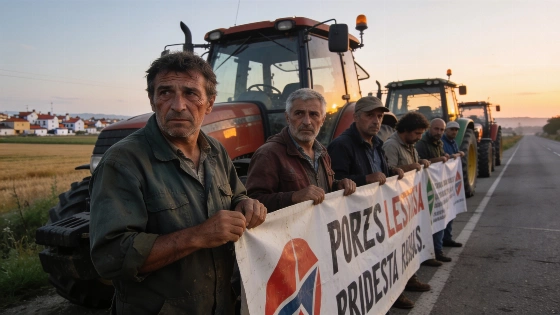
Spain’s main farming unions are mobilising for mass protests after agricultural diesel prices surged 48% in a year. With state subsidies about to expire and no alternatives offered, producers warn their livelihoods and the country’s food supply are at risk.
Spain’s leading farming unions—Asaja, COAG, and UPA—are preparing nationwide protests in response to what they describe as an “unbearable” rise in diesel prices. Agricultural fuel now costs 1.649 euros per litre, a 48% increase over the past year, according to official data from the Ministry of Agriculture. Producers say this surge has pushed many to a breaking point, threatening the viability of their businesses.
The immediate concern is the imminent end of state aid for agricultural diesel, which is set to expire on September 30. With less than two weeks left, farmers report that authorities have yet to present any concrete proposals or alternatives. The unions accuse the government of inaction, warning that “the countryside cannot wait any longer” as soaring fuel costs threaten to halt food production during the crucial sowing, grape harvest, and maize campaigns, with the olive harvest approaching.
The current compensation scheme for agricultural and fishing diesel provides up to 20 cents per litre, with a budget of 65 million euros allocated for this support.
In a joint statement, Asaja, COAG, and UPA highlight that the sharp increases in fuel and fertiliser prices—worsened since the outbreak of war in Iran—have made production costs unsustainable across all regions. They argue that farm profitability has “collapsed” and warn that, without immediate intervention, many operations could be forced to close or drastically cut output. As reported by several Spanish media outlets, the government’s "economic shield" for the sector will expire at the end of September, increasing pressure on policymakers to act quickly.
While the three main unions are coordinating their response, the Unión de Uniones de Agricultores y Ganaderos, also a member of the national agricultural advisory council, has stated it was not invited to join the planned protests. This group says it will decide on its own actions based on local conditions and the progress of each agricultural campaign, underscoring the lack of a unified strategy within the sector. Recent statements from the Unión de Uniones confirm this division among agricultural organisations.
So far, government officials have offered few concrete solutions. Agriculture Minister Luis Planas has said the cabinet is still “reflecting” on possible measures and expects a decision “in the coming weeks.” He described the situation in the Red Sea and the Strait of Hormuz as a “bad development” for global supply chains but stopped short of promising new support for Spanish farmers. Meanwhile, Economy Minister Carlos Cuerpo is scheduled to meet with food industry and fertiliser representatives to assess the economic impact of the conflict in Iran, but no immediate relief for farmers has been announced.
Minister Luis Planas has stated that the government is preparing new compensation measures for the diesel price increase, within the maximum allowed by the European Commission, and that this legal framework is valid until December 31. The government may cover up to 70% of the price increase, but the current aid is set to expire on September 30 unless extended.
The stakes are high: without affordable fuel, Spanish agriculture faces operational paralysis at a critical point in the production calendar. The unions’ call for sector-wide unity and street demonstrations reflects a widening rift between rural producers and policymakers. As the deadline for fuel aid approaches with no resolution, the government’s hesitation threatens not only the livelihoods of thousands of farmers but also the stability of Spain’s food supply chain. The coming weeks will reveal whether Madrid can deliver meaningful support or if rural discontent will erupt into large-scale protests.