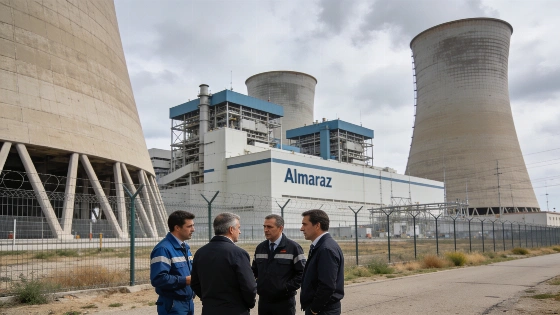
The Spanish government’s decision to extend Almaraz nuclear plant until 2030 has triggered a sharp conflict between PSOE and Sumar. The move breaks a key coalition promise and exposes new political fault lines.
The Spanish government’s unilateral extension of the Almaraz nuclear plant’s operations until 2030 has ignited a major dispute within the ruling coalition. Sumar, the junior partner, reacted with rare intensity after the measure appeared in the official state bulletin, denouncing the move as a fundamental breach of the coalition agreement and a capitulation to energy sector interests.
Under the coalition pact signed by Pedro Sánchez and Yolanda Díaz in October 2023, the government committed to a phased, socially just closure of all Spanish nuclear plants between 2027 and 2035. The extension of Almaraz’s Unit I and II—originally scheduled to close in 2027 and 2028—directly contradicts this timeline, undermining a central promise that Sumar had secured during negotiations. For Sumar, which has built much of its political identity around ambitious green policies and a clear break from PSOE’s approach, the decision is a significant setback.
Sumar’s leadership publicly expressed its “absolute disagreement” with the extension, warning that the move represents a deep rupture in government consensus. The party accused Sánchez of aligning with right-wing positions by allowing the plant to continue operating. Official sources from Sumar did not clarify whether they were informed in advance or learned of the decision only upon its publication, which came during the August holiday period.
Izquierda Unida, a key force within Sumar, described the extension as a mistake that breaks the government’s roadmap and signals inconsistency with renewable energy goals. IU leader Antonio Maíllo voiced concern that Almaraz could set a precedent for further nuclear extensions, suggesting the PSOE may be quietly shifting its stance on nuclear energy. He called for a strategy to prevent similar extensions at other plants scheduled to close in the coming years.
The nuclear debate in Spain has intensified over the past year and a half, especially after the major blackout of 2025. Opposition parties such as PP and Vox have used the incident to argue for the continued operation of nuclear facilities. In this context, the Almaraz decision is seen as a test of the coalition’s ability to maintain its green agenda. The issue now joins a growing list of internal disputes, including corruption, housing, defense, and labor reforms.
The coalition agreement’s section on the “green agenda for today and tomorrow’s sustainability” explicitly promised a planned, safe, and socially fair nuclear phase-out, following the Just Transition Strategy. The extension of Almaraz, however, has cast doubt on the credibility of this commitment and raised questions about the future direction of Spain’s energy policy.
For additional context, the debate over Spain’s energy infrastructure has been shaped by recent crises, such as the 2025 blackout, which prompted regions like Catalonia to introduce rapid-response measures to restore essential services. For example, Catalonia recently deployed a mobile unit to restore phone coverage during emergencies, highlighting the broader challenges facing the country’s energy and communications networks.
Spain’s nuclear sector currently includes several plants with staggered closure dates, and any shift in policy could have significant implications for the country’s energy mix, regional economies, and climate commitments. The outcome of the Almaraz dispute may set the tone for future decisions on nuclear energy and coalition stability.