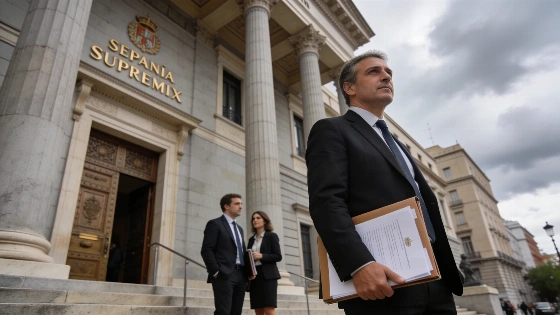
Spain’s Supreme Court has frozen the voting rights of new citizens registered under the so-called grandchildren law. The decision blocks their inclusion in the electoral roll until legal appeals are resolved. The move affects thousands of recent applicants.
Spain’s Supreme Court has suspended the right to vote for new citizens registered under the so-called "ley de nietos." The ruling stops these individuals from being added to the electoral roll, disrupting the government’s recent push to expand citizenship and voting rights for descendants of exiles from the Franco era.
The case began after Iustitia Europa and Vox challenged the automatic registration of new citizens in the Censo Electoral de Residentes Ausentes. They argued that this process threatened the integrity of elections. Their complaint targeted the 2022 Ley de Memoria democrática, which assumed that anyone who left Spain between 1936 and 1955 did so for political reasons, granting nationality without requiring documentary proof. This opened the door for thousands of descendants abroad to gain citizenship and voting rights.
As of September 2026, the Supreme Court is only considering precautionary measures, not a final ruling on the merits of the case.
The State Attorney’s Office and the government opposed the suspension, arguing that the law should remain in effect while appeals are ongoing. The Supreme Court, however, sided with the challengers. It ruled that while administrative procedures can continue, new citizens covered by the law cannot vote until the legal dispute is resolved.
The decision does not affect those who have already provided documents proving their ancestors’ exile. Only those who relied on the law’s presumption of political exile now face a suspension of their voting rights. This creates a divide among new Spanish citizens: some keep their rights, while others are left waiting.
The controversy stems from the government’s effort to address historical injustices through the Ley de Memoria democrática. By making it easier for descendants of exiles to gain citizenship, the law aimed to recognize families forced to flee during the Franco dictatorship. But the automatic link between nationality and voting rights quickly became a point of contention, especially as parties like Vox challenged the reforms in court.
The Supreme Court has requested the full administrative file from the Central Electoral Commission (JEC), indicating that the court is examining not only the political dispute but also the technical process of automatic voter registration.
For many families abroad, the suspension means they must wait longer to participate in Spanish elections. The ruling also shows the courts’ caution toward broad presumptions in citizenship policy, especially when they affect voting. As reported earlier, the Supreme Court has faced pressure to clarify the rules around voting rights for new citizens, with both legal and political stakes involved.
This episode highlights how reforms based on historical memory can run into legal and political resistance. The government’s plan to expand the electorate through the grandchildren law now faces a major test, with the courts closely examining both the law and its real-world effects. The case shows that in Spain, the intersection of history, law, and politics remains deeply contested, and efforts to address the past can quickly become part of current political battles.