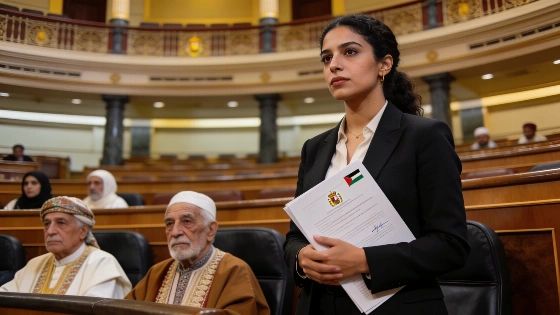
Spain has approved a law restoring citizenship to Sahrawis born in Western Sahara. Deputy Tesh Sidi now shifts focus to the risks of artificial intelligence, calling it a greater danger than fascism. The move signals a new phase in Spain’s digital and migration policy.
Artificial intelligence has become a new focus for Spanish lawmakers. Tesh Sidi, deputy for Más Madrid, now calls it a greater threat than fascism, comparing its impact to that of the atomic bomb. Her warning comes just as Congress approved a law restoring Spanish nationality to people born in Western Sahara during the colonial period—a measure Sidi championed from the beginning.
The law, delayed for more than a year and a half, finally passed the lower house after a coordinated effort by government allies. Sidi credits the breakthrough to an unusual moment of unity among left-leaning parties and targeted pressure on the PSOE, especially after Sahrawis were left out of earlier immigration regularizations. Congress president Francina Armengol played a key role in overcoming internal resistance and getting the measure to a vote. According to Al Jazeera and EFE, the law was approved by the Spanish Congress on September 10, 2026, with 168 votes in favor, 31 against, and 145 abstentions, highlighting both its importance and the political divisions around it.
The law introduces a special procedure allowing Sahrawis to apply for citizenship without the usual 10-year residency requirement, marking a major departure from standard Spanish naturalization rules.
For Sidi, the legislation is personal. Born in a refugee camp in Tinduf, Algeria, she says this law is the reason she entered politics. Seeing older Sahrawis return to the Spanish parliament after fifty years, dressed in traditional clothing and speaking their language, was a symbolic restoration of identity and memory—something she considers even more important than the legal status itself. RTVE reports that the law still needs to pass the Senate and be published in the BOE before it takes effect. After that, applicants will have up to four months to prepare their documents.
The political climate remains tense. Sidi admits there were concerns the PSOE might reverse course, especially after the crisis in Ceuta, but says that by the time of the vote, the government had no room to back out. The PP abstained, which Sidi calls a lack of courage, showing the absence of cross-party agreement on Sahrawi rights despite years of public support. According to Democrata, the law passed after sustained pressure from Sumar and other left-wing allies, with the PSOE initially resisting before supporting the measure under Francina Armengol's leadership.
With the law passed, Sidi is now focused on the impact of artificial intelligence on Spain’s labor market. As vice president of the Economy, Commerce and Digital Transition Committee, she warns that automation will lead to mass job losses, and says the left is not facing the scale of the problem. She argues that the concentration of wealth and power among a digital elite now threatens democracy, and that there are no clear policies yet to protect citizens.
Estimates published by Al Jazeera and Morocco World News suggest that between 70,000 and up to 90,000 Sahrawis and their direct descendants could potentially benefit from the new citizenship law, provided they can present documents such as old Spanish DNI, birth certificates, or UN-verified census records from the Western Sahara referendum period.
Sidi also criticizes the government’s handling of recent migration crises, especially the communication failures that, in her view, allowed far-right narratives and violence against minors to spread. She points out that publishing sensitive documents without context only created confusion, and that social networks—mostly controlled by private companies—have become a destabilizing force that can overwhelm state institutions. The events in Ceuta, reported earlier, show how quickly digital mobilization can turn into real-world unrest.
Sidi says Spain urgently needs a new strategy for managing both migration and digital threats, calling for a coordinated state policy that bridges regional and national divides. She remains committed to political action, regardless of her role in 2027, and sees the debate over AI-driven job losses as the next major fight for social justice.
Her view is direct: fascism is dangerous, but artificial intelligence is a more complex and unpredictable risk. Its dual-use nature—capable of both progress and harm—requires immediate attention from lawmakers. Sidi argues that Spain is still legislating for the past, while the future, shaped by AI and digital power, is arriving faster than its institutions can keep up. The new citizenship law is a long-overdue correction, but the bigger test for Spain’s democracy may be how it responds to the changes already underway in its economy and society.