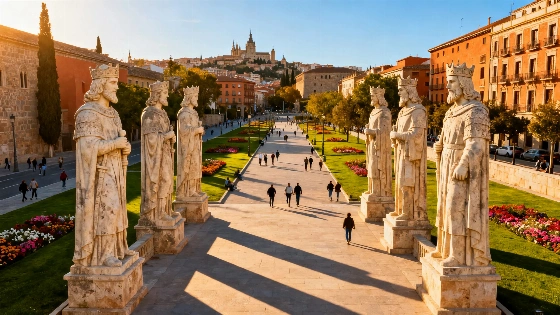
Toledo has reopened its main historic centre access as an 'Imperial Walk', featuring restored statues of six Visigothic and Christian kings. The project improves accessibility, green spaces and public amenities, with a €3.2 million investment.
The main gateway to Toledo’s historic centre has reopened after a six-month transformation, introducing a striking 'Paseo Imperial' flanked by six monumental statues of Visigothic and Christian monarchs. The city’s mayor, Carlos Velázquez, highlighted that the new entrance from Paseo de la Vega now reflects Toledo’s historical stature, welcoming visitors with restored limestone figures of Wamba, Sisenando, Sisebuto, Alfonso VI, Alfonso VII and Alfonso VIII. These statues, which arrived from Madrid’s Royal Palace over two centuries ago and had become obscured by vegetation, have undergone extensive cleaning and restoration to remove years of lichen and neglect.
The renovation, funded with €3.2 million from European sources, extends beyond the boulevard. The entire Parque de la Vega has been overhauled, with new landscaping, improved lighting, and more than 200 new trees and shrubs planted. Accessibility has been a priority: pavements have been rebuilt, architectural barriers removed, and parking reorganised to nearby areas. The project also includes adapted toilets for ostomised users and a large children’s play area, aiming to make the park more inclusive and family-friendly.
Hospitality in the park has also changed. Six new kiosks have been constructed, replacing older structures. However, two long-standing businesses, El Parque and Casa Mariano, have closed after opting out of the city’s new concession process due to higher monthly fees. The well-known churrería Catalino remains open, continuing to serve locals and tourists year-round.
The reopening comes shortly after a fire damaged the roof of the Casa de Corcho, a late 19th-century Swiss-style building that was set to reopen as a hospitality venue. Restoration of its cork and wood roof is underway, with completion expected later in the year. According to Velázquez, the Casa de Corcho’s rehabilitation was always planned for a later phase, likely between October and November.
To mark the reopening, the city has organised a programme of sports, cultural and musical events. From Monday, the boulevard will also reopen to vehicle traffic, though on many weekends it will be closed for public activities. The city government, led by PP and Vox, sees the new Paseo Imperial as a key space for leisure and culture, with the aim of enhancing green areas and public life in Toledo.
An exhibition, 'Memoria del Parque de la Vega', now traces the history of this central park through twelve panels of archival images and documents. The display recalls how the former Paseo de Merchán became a focal point for outdoor gatherings, family events and local traditions since the late 19th century. The park, known simply as La Vega, has hosted fairs, concerts and markets, including the FARCAMA craft fair, and remains a vital part of Toledo’s collective memory.
The Casa de Corcho’s architectural and historical significance is also highlighted in the exhibition, which details its origins, preservation efforts and role in the city’s landscape. The overall renovation returns a key green space to Toledo’s residents, adapted to modern needs while preserving its heritage. Across Spain, similar projects have aimed to balance historical preservation with accessibility and public use, reflecting a broader trend in urban renewal.