A fast-moving wildfire in Almería’s Sierra de la Cabrera-Bédar has left 12 dead and 23 missing. Over 1,400 residents have been evacuated. Emergency services are battling extreme conditions to contain the flames.
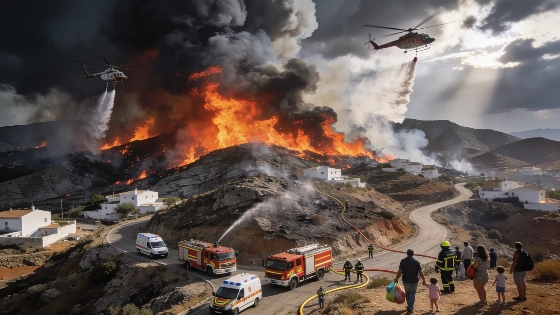
A devastating wildfire swept through the Sierra de la Cabrera-Bédar in Almería on Thursday, resulting in at least 12 fatalities and 23 people unaccounted for. The blaze, which quickly became one of the deadliest in Andalusia’s recent history, forced the evacuation of more than 1,400 residents from towns including Bédar, Los Gallardos, Almocáizar, and Alfaix. Emergency teams, supported by 32 aircraft and 13 fire engines, have been working around the clock to contain the fire, which has already consumed 4,000 hectares of land.
The first alert reached the Andalusian emergency services at 16:35, reporting flames near Almocáizar in Los Gallardos. Within minutes, local officials and police began warning residents as the fire, likely sparked by a fallen power line along the N-340A, spread rapidly through dry vegetation. By 17:30, flames were advancing toward El Pinar, prompting door-to-door warnings and, in some cases, instructions for residents to shelter indoors due to the speed and unpredictability of the fire’s movement.
Strong winds from the southwest, gusting up to 50 km/h, and temperatures reaching 40°C accelerated the fire’s spread. The situation escalated quickly, with the regional emergency plan raised to operational level 1 by 20:08. Preventive evacuations began in scattered housing areas, and by nightfall, the entire Los Gallardos campsite—hosting around 400 people—was cleared in under ten minutes as staff urged guests to leave immediately. Many evacuees watched the flames approach from the safety of the main road, realizing the scale of the threat only as they escaped.
As night fell, the fire entered ravines and hillsides dotted with isolated homes, complicating rescue efforts. Some residents became trapped while attempting to flee via secondary roads. Firefighters from Plan Infoca conducted controlled burns in the north and near the campsite to halt the fire’s advance. The Junta de Andalucía requested military support, and by early morning, 220 members of the Unidad Militar de Emergencias (UME) were on site, reinforcing containment lines and operating heavy machinery.
Tragically, the first victims—mainly British and Belgian nationals living in rural homes or visiting on holiday—were discovered overnight. Around 1:00, Bédar’s mayor and fire crews found a group of ten who had ignored advice to stay indoors and became trapped on a dead-end path. Only two were rescued with severe burns; the remaining eight perished. By Friday afternoon, the number of missing had risen to 23, though only three official disappearance reports had been filed, according to the Interior Ministry.
Throughout Friday, the Guardia Civil conducted systematic searches of rural properties and paths around Bédar, seeking survivors and additional victims. Precautionary evacuations extended to a tourist complex near Alfaix due to heavy smoke, though flames did not reach the area. The fire’s perimeter continued to expand, surpassing 4,000 hectares by the end of the day, with the situation remaining unstable due to challenging terrain, scattered housing, and persistent adverse weather.
The wildfire has primarily affected Los Gallardos and Bédar, while also threatening Turre, Antas, Mojácar, and Garrucha. Authorities are focusing on protecting lives, locating the missing, and stabilizing the fire’s perimeter. The scale of the tragedy recalls other deadly incidents in Spain, such as the 1984 La Gomera fire and the 1979 Lloret de Mar disaster. In the context of recent emergencies, the rapid mobilization and coordination of local, regional, and military resources have been critical, echoing the swift responses seen in other Spanish crises, including the evacuation of residents in Barcelona following a major sinkhole.
Spain’s geography and climate make it particularly vulnerable to wildfires, especially in regions like Almería where dry conditions and strong winds are common. The Sierra de la Cabrera-Bédar, with its steep ravines and scattered settlements, presents unique challenges for emergency services. The current incident highlights the ongoing need for robust prevention, rapid response, and clear communication with residents in high-risk zones. As authorities continue their search and containment efforts, the focus remains on minimizing further loss and supporting those displaced by the disaster.