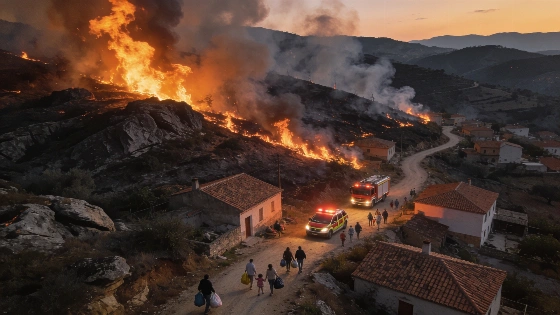
A wildfire near Bédar, Almería, left 12 dead and nine injured after flames spread rapidly through scattered homes. Local authorities used megaphones and church bells to warn residents. Difficult terrain and strong winds complicated evacuations.
Twelve people lost their lives and nine were injured, four seriously, after a fast-moving wildfire swept through the municipality of Bédar in Almería. The fire, which broke out near the Almocáizar area in neighboring Los Gallardos, quickly advanced toward the scattered settlements of Bédar, catching many residents off guard. Local authorities, led by mayor Francisco Collado, launched an urgent door-to-door evacuation, using police megaphones and even the church bells to alert the population as the flames approached.
The fire started when an abandoned private power line collapsed, igniting dry vegetation along the roadside. Within minutes, strong winds—reaching up to 50 kilometers per hour—drove the blaze across difficult terrain filled with ravines and barrancos, making access and communication extremely challenging. The presence of dozens of isolated homes further complicated the evacuation, as emergency teams struggled to reach everyone in time.
Initial instructions directed residents to evacuate toward Los Gallardos via the provincial road, but as the fire threatened to cut off this route, the mayor redirected people back to the town center and then toward a forest track leading to Lubrín. This quick decision is believed to have saved many lives. Around 200 people spent the night in temporary shelters set up in Antas, Lubrín, and Garrucha, while over a hundred firefighters, supported by 80 members of the Military Emergency Unit and 30 aerial units, battled the flames from early morning.
Some residents, particularly in the Curato area, were told to stay inside their homes for safety. However, a group of nine attempted to escape via a farm track, only to find themselves trapped with no exit. Only two survived, both with severe burns, and were transferred to specialized burn units in Almería and Sevilla. The rest, including several foreign nationals from Belgium and the United Kingdom, perished. Another group of four British residents tried to flee by car through a dry riverbed, which turned into a deadly trap as the fire closed in.
Material damage was extensive, with entire neighborhoods and a campsite in Los Gallardos affected. The A-7 motorway was temporarily closed to allow emergency services to operate safely. The regional government set up an advanced command post in Turre to coordinate the response, as thick smoke and flames continued to threaten nearby communities.
Wildfires in Spain have become increasingly destructive in recent years, often fueled by drought, high winds, and the spread of rural homes into forested areas. The tragedy in Bédar highlights the risks faced by small municipalities with scattered populations and limited evacuation routes. In a similar incident, Barcelona authorities recently evacuated four buildings after a massive sinkhole endangered residents, as reported in coverage of the Putxet district emergency. Both cases underscore the growing challenges for emergency services in responding to sudden disasters across Spain's diverse landscapes.
According to official data, Spain has seen a rise in wildfire-related fatalities and property losses over the past decade, particularly in regions with complex geography and dispersed settlements. The Bédar incident serves as a stark reminder of the importance of rapid communication, coordinated evacuation plans, and investment in rural infrastructure to mitigate future risks. Local authorities continue to assess the damage and support affected families as recovery efforts begin.