The fourth San Fermín encierro brought chaos as Álvaro Núñez bulls split from the herd. Two men suffered severe injuries, one now in intensive care. The run lasted just 2:30 minutes, with multiple medical incidents.
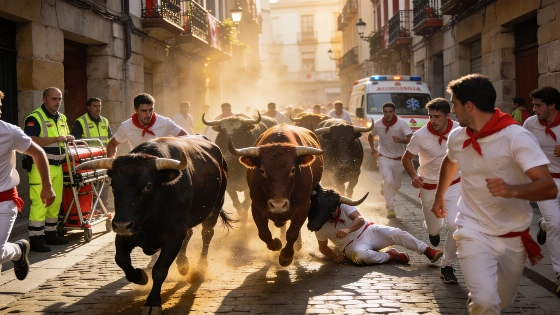
Two men are in serious condition after a dramatic fourth encierro at San Fermín, where Álvaro Núñez bulls charged through Pamplona at breakneck speed. The run, lasting only two and a half minutes, saw the herd split early, creating unpredictable gaps and raising the risk for runners along the route. Emergency services responded to nine medical incidents, with one man now in intensive care after sustaining a bilateral pneumothorax.
The tension began at Santo Domingo, where the bulls outpaced the cabestros from the start. This separation led to scattered groups and forced runners to make split-second decisions as the animals surged ahead. At the notorious Mercaderes curve, two black bulls collided with the barriers, causing a heavy impact that left several runners exposed. The cabestros eventually regained the lead, but the damage was done—multiple falls and near-misses followed as the bulls continued down Estafeta at high speed.
Throughout Estafeta, the spread-out herd allowed for some of the most daring sprints, but also resulted in dangerous pile-ups. In one instance, a brown bull lagged behind and tumbled onto a group of runners near Telefónica, entering the arena alone but without further incident thanks to the intervention of the trailing cabestros. The rapid pace and unpredictable movement of the bulls kept both participants and onlookers on edge throughout the run.
Medical teams reported two critical injuries. The most severe case involves M.C.M., a 65-year-old from Castro del Río (Córdoba), who was rushed from the Plaza de Toros with chest trauma and remains in the intensive care unit. The second, F.G.L., a 63-year-old resident of Zizur Mayor, suffered a fractured left hip on the Santo Domingo stretch and is also listed in serious condition at the Hospital Universitario de Navarra.
This year’s encierro stands in sharp contrast to previous runs, where the herd often stayed tightly packed and injuries were less severe. For example, during the third day, the Victoriano del Río bulls led a fast but more controlled run, resulting in only minor injuries, as detailed in coverage of the previous encierro. The latest incident highlights the unpredictable nature of the festival and the ongoing risks faced by participants.
Later today, Álvaro Núñez bulls will return to the spotlight in the afternoon corrida, featuring Morante de la Puebla, Borja Jiménez, and Pablo Aguado. The San Fermín festival remains one of Spain’s most iconic and closely watched events, drawing thousands of visitors and requiring extensive coordination between medical teams, local authorities, and event organizers. The combination of tradition, adrenaline, and real danger continues to define the spirit of Pamplona each July.
San Fermín’s encierros are renowned for their speed and unpredictability, with each run presenting unique challenges for both runners and emergency responders. The event’s structure—with bulls and cabestros released together—aims to minimize chaos, but as seen this year, even small changes in herd dynamics can have significant consequences. The festival’s medical infrastructure is among the most advanced for such events, with rapid response teams stationed along the route and at the hospital. Despite these precautions, the risk of serious injury remains a defining feature of the tradition, underscoring the enduring tension between celebration and danger in Pamplona’s streets.