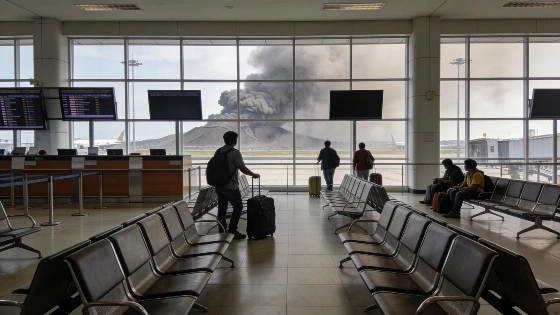
Six airports in Indonesia, including Jakarta’s main hub, have suspended operations after Anak Krakatoa erupted. Over 370 flights are disrupted. Authorities cite volcanic ash as the cause, with no clear timeline for reopening.
Flights in and out of Indonesia’s busiest airports stopped this weekend after Anak Krakatoa erupted, forcing authorities to close six major air hubs, including Jakarta’s Soekarno-Hatta. More than 22,000 passengers were left stranded, and over 370 flights were canceled or delayed, disrupting travel across Southeast Asia.
Volcanic ash from the eruption drifted over runways and airspace, leading the Ministry of Transport to halt all activity at five airports on Java—Soekarno-Hatta, Halim Perdanakusuma, Budiarto, Pondok Cabe, and Husein Sastranegara—as well as Radin Inten in Sumatra. The closures, announced after Friday night’s eruption, remain in place with no set end date while officials continue to monitor air safety.
— Indonesia’s Meteorology, Climatology, and Geophysics Agency
Soekarno-Hatta, Jakarta’s main airport and a key regional hub, has seen the most disruption. Since 1:30 a.m. local time, 172 flights have been canceled, 18 delayed, seven postponed, four diverted, and one forced to return after takeoff. International routes to Singapore, Hong Kong, Sydney, Seoul, Doha, Amsterdam, and Kuala Lumpur are affected, along with domestic flights to Lampung, Surabaya, and Bali’s Denpasar.
Anak Krakatoa, which means "child of Krakatoa," sits in the Sunda Strait between Java and Sumatra. Its activity is closely watched after the 2018 eruption and tsunami that killed 425 people and injured thousands. This time, Indonesia’s Geological Agency director Lana Saria said there is no tsunami risk, noting that the volcano’s current structure does not threaten a collapse like in 2018.
Volcanic ash has spread across Banten, West Java, Jakarta, Lampung, and Bengkulu provinces. The Ministry of Transport says airports will reopen only when ongoing checks confirm it is safe to fly. The impact is immediate for travelers, airlines, and logistics, with effects rippling through the region’s air traffic.
— International Air Transport Association
Disruptions like this are not unusual in Indonesia, a country of 17,000 islands along the Pacific’s Ring of Fire. It experiences around 7,000 earthquakes a year and has some of the world’s most active volcanoes. Anak Krakatoa itself appeared in 1927 from the remains of Krakatoa, whose 1883 eruption killed over 36,000 people and changed global weather for months.
While this eruption has not caused casualties or structural collapse, memories of past disasters keep authorities cautious. The government’s decision to keep airports closed, despite the economic cost, shows a clear focus on safety in a country where air travel is essential. As seen in other recent disruptions, such as the closure of Barcelona’s García Márquez Library due to staff strikes, shutting down key infrastructure quickly reveals how fragile essential services can be.
Indonesia’s response to Anak Krakatoa’s eruption reflects lessons learned from past crises. The indefinite airport closures, though costly, underline a simple calculation: in a place where nature is unpredictable, public safety comes first.