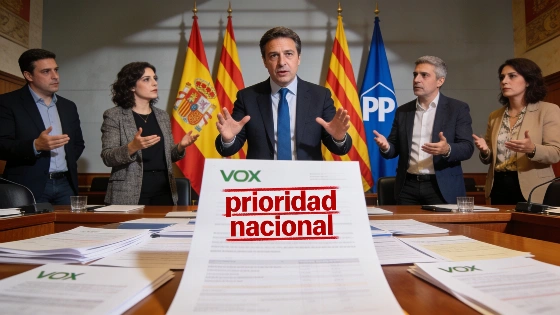
Vox demands the 2026 Valencian budget explicitly include 'prioridad nacional'. The PP needs Vox's support to pass the accounts. Opposition parties challenge the move, escalating the political standoff.
The political standoff in the Valencian Community has intensified as Vox insists that the 2026 Generalitat budget must explicitly enshrine the principle of 'prioridad nacional'. José María Llanos, Vox's spokesperson in Les Corts Valencianes, declared that this would make Valencia the first region in Spain to formally include the controversial clause, which the party links to social services and housing access. The demand has become a non-negotiable condition for Vox's support, putting pressure on the Partido Popular (PP) government led by Juanfran Pérez Llorca.
Vox's votes are essential for the PP to secure a majority in Les Corts. Earlier this month, the regional finance minister, José Antonio Rovira, argued that the budget could not reflect such a principle, as it is a financial document focused on numbers. Despite this, Llanos maintains that the ongoing negotiations with the PP have always centered on three pillars: national priority, security, and immigration and housing. He highlighted that Vox has already negotiated several amendments, including doubling the allocation for international cooperation on immigration from €300,000 to €600,000, and introducing a €2.5 million fund for the return of former unaccompanied minors.
The PP, however, disputes the extent of these talks. Mari Carmen Contelles, a PP deputy, stated that her party had not formally sat down with Vox to negotiate the amendments, despite registering 156 partial amendments to their own budget. She indicated that the PP would review Vox's proposals alongside those from other groups once they are officially submitted. This conflicting narrative has fueled uncertainty over the final content of the budget, with Llanos challenging the PP's version of events and questioning which account should be believed.
Meanwhile, the opposition has mounted a strong response. The PSPV-PSOE has filed a record 4,032 partial amendments, aiming to remove the 'prioridad nacional' clause and redirect €3.669 billion in line with the new national funding model proposed by the central government. Socialist spokesperson José Muñoz criticized the budget as serving only the interests of President Llorca and Santiago Abascal, Vox's national leader, branding the accounts as 'Erasmus budgets' unlikely to be implemented in time. Compromís, for its part, plans over 1,000 amendments focused on education, health, housing, social services, environment, agriculture, culture, humanitarian aid, and the Acadèmia Valenciana de la Llengua. The coalition advocates for a 'prioridad valenciana' instead of Vox's national focus, seeking a total challenge to the PP's financial plan.
This dispute over the 2026 budget comes amid broader tensions in Spanish politics, where coalition dynamics and regional interests frequently collide. The situation in Valencia echoes similar power struggles seen elsewhere, such as the recent internal conflicts within PSOE over primary races in key regions, as reported in coverage of PSOE's early candidacies and Madrid tensions. These developments highlight the growing complexity of regional governance and the pivotal role of smaller parties in shaping policy outcomes.
For context, the Generalitat Valenciana is the autonomous government of the Valencian Community, responsible for regional legislation and budget management. The principle of 'prioridad nacional', promoted by Vox, seeks to prioritize Spanish nationals in access to public services and benefits, a stance that has sparked controversy and legal debate across Spain. The outcome of the current negotiations will likely set a precedent for other regions and could influence national policy discussions ahead of future elections. As the budget process unfolds, all eyes remain on Valencia to see whether the PP and Vox can reach an agreement or if opposition parties will succeed in blocking the proposed changes.