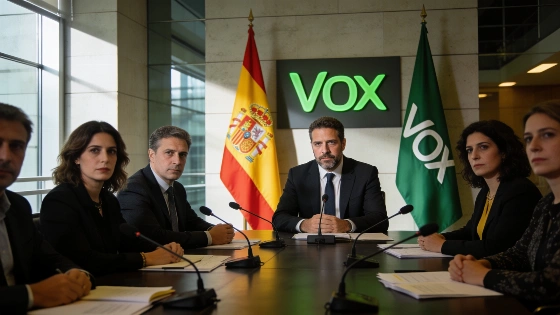
Santiago Abascal has warned the PP that Vox may leave regional governments if coalition deals are not strictly followed. The party also unveiled a deregulation plan inspired by Argentina’s Milei. The move could impact key rules and public services.
Vox leader Santiago Abascal has issued a direct warning to the Partido Popular (PP), making it clear that his party is prepared to withdraw from regional coalition governments if existing agreements are not fully respected. Speaking in Madrid alongside regional vice presidents Oscar Fernández Calle (Extremadura), Alejandro Nolasco (Aragón), and Carlos Pollán (Castilla y León), Abascal emphasized that Vox will closely monitor the implementation of coalition deals in all three autonomous communities. He called on his party’s regional leaders to be ready to leave government positions if they encounter further obstacles or breaches, referencing Vox’s previous decision to exit a coalition in July 2024.
Abascal described the current period as the most challenging for Vox, highlighting the party’s new responsibilities in government and the scrutiny it faces ahead of the next general elections, expected within a year. He urged his colleagues to uphold party principles and maintain a firm approach in applying agreed policies, despite Vox’s status as a junior coalition partner.
Vox’s new deregulation program, presented in Madrid, draws inspiration from the policies of Argentine President Javier Milei, with whom Abascal recently met. Unlike Milei’s claim of repealing 16,000 regulations, Vox has not specified a target number but promises to eliminate three regulations for every new one introduced. The party’s focus includes rolling back rules on labor relations, such as equality and LGTBI plans, working time records, sustainable mobility plans, and digital disconnection protocols. Vox also proposes adapting workplace risk plans to each company and reforming the Workers’ Statute, though details remain unclear.
The party’s agenda includes introducing a nationwide economic license to unify the Spanish market, applying positive administrative silence except for nationality and immigration procedures, and removing the requirement for prior appointments in official processes. Vox also wants to create a single database to prevent citizens from submitting documents already held by the administration. The plan calls for repealing laws on housing, climate change, and labor reform, as well as amending regulations on energy, taxation, industry, and data protection—stripping the data protection agency of its sanctioning powers. Changes to whistleblower protection laws are also proposed, though the purpose is not specified.
During the deregulation plan’s presentation, Vox’s secretary general Ignacio Garriga highlighted the party’s record of “zero corruption cases.” The party’s accounts for the previous year were ratified online with 98.2% approval, but the number of participating members was not disclosed. Responding to criticism from Prime Minister Pedro Sánchez, Abascal defended the transfer of €13.9 million over six years from Vox to the Disenso foundation, where he serves as president and permanent trustee. He stated that Disenso’s mission is to monitor “communists, drug traffickers, and criminals” in Latin America and indicated plans to increase funding for the foundation in 2025.
Garriga also defended Vox’s “national priority” policy, which restricts immigrants’ access to public aid and services, insisting it is a matter of social justice rather than racism or xenophobia. He criticized business groups, unions, and elements of the Catholic Church hierarchy for opposing this stance. At the party’s annual assembly, Abascal intensified his criticism of Sánchez, using harsh language to describe the prime minister’s leadership.
Spain’s political landscape has seen increasing tension between coalition partners at both regional and national levels. Vox’s threat to exit regional governments could disrupt local administrations and affect the implementation of key policies. The party’s deregulation agenda, if enacted, would mark a significant shift in labor, administrative, and social regulations across several autonomous communities. As the next general elections approach, the stability of these coalitions and the direction of policy reforms remain in focus.
For context, coalition governments between PP and Vox have been a feature in several Spanish regions since 2023, often marked by disputes over policy priorities. The “administrative silence” principle, which Vox seeks to expand, is a legal mechanism in Spain that allows certain requests to be approved automatically if authorities do not respond within a set period. The Disenso foundation, mentioned by Abascal, is known for its activities in political advocacy and research. These developments come amid ongoing debates over decentralization, labor reform, and the role of minority parties in Spanish governance.