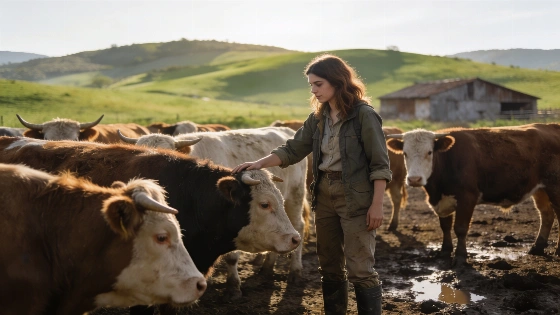
Ana Hernández left city life behind to take over her family’s cattle farm in Valderrodrigo, Salamanca. Her decision highlights the generational crisis in Spanish agriculture and the personal cost of choosing passion over stability.
Ana Hernández did not follow the path many expect from young professionals in Spain. After a period living in Seville, she returned to her hometown of Valderrodrigo, Salamanca, to take charge of her family’s cattle farm—a move that stands out in a sector where fewer than 9% of farm owners are under 41, according to the Ministry of Agriculture.
For Ana, the appeal of the countryside outweighs the predictability of a public sector job. She openly rejects the notion that success means a fixed schedule and a government paycheck. “Everyone thinks success is becoming a civil servant and working from 7 to 3, but I’d rather work all day at something I truly care about,” she says. The reality is demanding: livestock work is relentless, shaped by the needs of animals and the unpredictability of weather and disease. Yet, for Ana, the autonomy and sense of purpose are worth the trade-off.
Family Legacy and Setbacks
Ana’s decision was shaped by her family’s history. Her father spent years building the farm, only to see it nearly destroyed in 2016 by a tuberculosis outbreak that forced them to rebuild from scratch, importing cattle from France. The effort to recover the business weighed heavily on Ana. “After everything my father went through, I couldn’t let the farm disappear or end up in someone else’s hands,” she explains.
Her story echoes a broader trend of young Spaniards returning to rural roots, often after time in the city. As noted in a recent report on Castilla-La Mancha’s pistachio boom, the challenge of generational renewal is not unique to livestock—many agricultural sectors struggle to attract and retain young talent.
Redefining Success
What sets Ana apart is her view of work. She values the unpredictability and ownership that come with running a farm. “It’s yours, every day is different. It’s not an office, not something routine,” she says. Her days are long and shaped by the animals’ needs, but the satisfaction of keeping the family business alive outweighs the lure of a steady, clock-bound job.
Government programs like the Programa Cultiva aim to support young farmers and women in agriculture, but the numbers remain stark: women make up just 32% of farm owners, and many more work without official recognition. The 2011 law on shared ownership was designed to address this, but progress is slow.
Women and the Rural Gap
Ana’s experience also highlights the gender gap in Spanish agriculture. The 2020 Agricultural Census counted just over 250,000 women among nearly 790,000 farm owners. Many more contribute without formal status, a reality the Ministry of Agriculture acknowledges. The continuity of family farms is not just about economics—it also helps sustain rural communities and landscapes. In places like Santiago-Pontones, large-scale sheep grazing is used to manage vegetation and reduce wildfire risk, supporting both the land and the local population.
Uncertainty Remains
Despite her commitment, Ana faces constant uncertainty. Bovine tuberculosis remains a threat, capable of upending even the best-laid plans. “You can have everything planned, but a single outbreak can change everything,” she says. The Ministry of Agriculture continues to monitor and fight the disease, but for farmers like Ana, the risk is always present.
Ana Hernández’s story is a reminder that for some, fulfillment comes not from stability, but from the challenge of building something personal—even when the odds are long and the future uncertain.