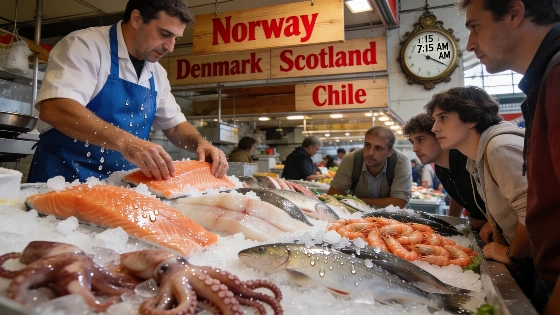
Despite a long-standing belief that Monday is a bad day to buy fresh fish in Spain, imported seafood from Norway, Denmark, Scotland, and Chile is widely available at the start of the week. For truly fresh Spanish-caught fish, most markets in Madrid only receive new arrivals late Tuesday night, making Wednesday the best day for local seafood.
At the Mercado de la Paz in Madrid, José Antonio Oñate stands behind his counter, fielding a question that has puzzled Spanish shoppers for generations: is it really true that you shouldn't buy fresh fish on Mondays? The answer, he says, is more nuanced than tradition suggests.
For decades, many Spaniards have avoided purchasing fish at the start of the week, convinced that Monday's catch is old stock left over from Friday. The logic was simple: most Spanish fishing boats do not work over the weekend, so anything on sale Monday must have been caught days earlier. But as Oñate points out, this rule no longer fits the reality of today's seafood trade.
Imported Fish on Mondays
"There's a myth that you can't eat fish on Mondays, but that's not true," Oñate explains in a video shared by the market. While it's accurate that Spanish fleets typically stop fishing on Friday and only return to sea early Monday morning, this gap is filled by a steady flow of imported fish. On Mondays, major wholesale markets like MercaMadrid receive fresh shipments flown in from Norway, Denmark, Scotland, and Chile. Some of these deliveries also arrive by train.
This means that the fish available in Madrid's markets at the start of the week is often just as fresh as any other day—it's simply not Spanish. For consumers who prioritize freshness above all, imported seafood can be a reliable option on Mondays, provided they are aware of its origin.
When Does Spanish Fish Arrive?
For those seeking Spanish-caught fish, timing is everything. Most Spanish fishing crews return to work in the early hours of Monday, heading out to sea after a weekend ashore. Their catch is landed at ports late Monday or early Tuesday, then loaded onto trucks bound for wholesale markets.
According to Oñate, these national catches typically reach MercaMadrid between 11 p.m. and midnight on Tuesday. As a result, Wednesday morning is the first opportunity for Madrid fishmongers to offer truly fresh Spanish seafood. This schedule makes Wednesday the prime day for shoppers who want local fish that has just arrived from the coast.
Coastal Cities Get It Sooner
The timeline is different in Spain's port cities. In places like Vigo, Barcelona, or San Sebastián, proximity to the sea allows fishmongers to sell local catches much sooner. If boats leave port early Monday, their haul can be available in local markets by Monday afternoon or evening, depending on weather and fleet activity. Restaurants in these cities may also serve fish caught that same day, especially later in the evening.
However, even in coastal areas, the availability of same-day catch depends on several factors: the size of the fleet, sea conditions, and the speed of unloading at the port. Early on Monday, it is still rare to find fish caught that morning, but by nightfall, the freshest local seafood is often on offer.
Quality and Choice
Oñate emphasizes that imported fish sold on Mondays is not necessarily inferior. The difference lies in its origin and the logistics of its journey, not in its freshness. For many consumers, imported seafood is a high-quality, safe choice at the start of the week. But for those who specifically want Spanish fish and want to know exactly when it was caught, patience pays off—Wednesday is the day to visit the market.
As Spain's seafood supply chain becomes more global and efficient, the old rules about when to buy fish are evolving. Understanding the journey from sea to market helps shoppers make informed choices, whether they are seeking the best of Spain's own waters or the finest imports from abroad.