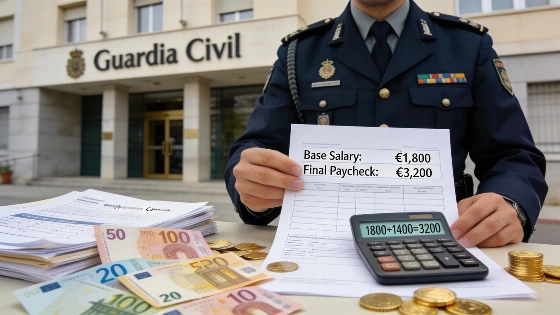
A viral video by an opposition exam instructor has reignited debate over Guardia Civil salaries. While the official base pay is under €1,000, most officers take home much more thanks to a complex system of bonuses and allowances. Here’s how the numbers add up.
When Marta, an instructor at the Patrio Civil academy, posted a video explaining Guardia Civil salaries, she touched a nerve. Her breakdown revealed a reality that surprises many: although the official base salary for a Guardia Civil officer is just €900, most end up earning between €1,700 and €2,100 per month. The difference comes from a web of bonuses, allowances, and personal factors that shape each officer’s final paycheck.
According to the latest figures from Spain’s Ministry of Finance, the base salary for a Guardia Civil in the C1 sub-group will stand at €900.63 gross per month in 2026, paid over 12 regular monthly payments. Extra payments in June and December are slightly lower, at €778.42 each. This brings the basic annual salary to €12,364.40 before any additions.
Beyond the Base: How Pay Grows
But the base salary is only the starting point. The law governing Guardia Civil personnel places all ranks from Cabo Mayor down to Guardia Civil in the C1 group for pay purposes. Every three years of service adds a seniority bonus—€32.96 per month on regular paychecks, and €28.45 on the extra payments.
On top of this, every Guardia Civil receives a 'complemento de destino' (post allowance) for holding a level 17 position. In 2026, this adds €465.75 per month, or €6,520.50 annually. Combined with the base salary, this brings a typical monthly gross to €1,366.38, or €18,884.90 per year, before factoring in seniority and other supplements.
Why No Two Officers Earn the Same
The real variation comes from additional bonuses. The 'complemento específico' rewards the risks, responsibilities, and demands of police work. It has two parts: a general component tied to rank, and a special component for particularly tough or technical assignments. Productivity bonuses, overtime, and allowances for difficult postings or special duties can further boost pay, but these vary widely from one officer to another and even from month to month.
Personal circumstances also matter. Income tax withholdings and family status affect net pay, so two officers with identical roles may still see different amounts in their bank accounts. As Marta points out, the €1,700–€2,100 range is an estimate, not a guarantee for every member of the force.
Public Sector Demand Remains High
This renewed focus on Guardia Civil pay comes as the government has authorized one of the largest recent recruitment drives: 3,240 new direct-entry positions for the Escala de Cabos y Guardias in 2026. Of these, 1,296 are reserved for professional soldiers and sailors, and 240 for students from the Colegio de Guardias Jóvenes.
The Guardia Civil remains a popular choice for those seeking stable public sector employment, but the salary structure is anything but simple. The base salary is just one piece of a much larger puzzle, and understanding the full picture requires looking at all the moving parts.
For context, Spain’s system of public sector pay is designed to reward experience, responsibility, and hardship. While the base salary may seem low, the combination of bonuses and allowances means that most officers earn significantly more than the headline figure suggests.