

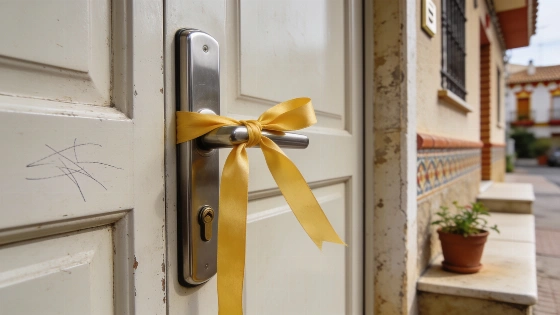
Tying a yellow ribbon to your front door handle has become a visible trend in Spain, symbolizing optimism and the hope for new opportunities. While the gesture carries personal meaning for many, there is no evidence it brings prosperity on its own.
A yellow ribbon tied to a front door handle is an increasingly common sight in Spanish neighborhoods, fueled by social media and personal rituals. For those who adopt this practice, the yellow ribbon is more than a decorative touch—it stands for optimism, energy, and the desire for a fresh start. The choice of the door handle is deliberate: it is a spot everyone in the household sees daily, serving as a constant reminder of the intention behind the gesture.
Symbolism Over Superstition
There is no universal meaning for a yellow ribbon on a home’s entrance. In this context, it is used as a symbolic object, representing positive thinking and the wish to invite change. The color yellow is associated with hope, prosperity, and forward movement. People often tie the ribbon when they want to mark a new chapter, improve their financial situation, or signal a personal or professional transition. Its main function is symbolic, acting as a visible prompt to stay focused on a goal.
This approach is similar to other household rituals—like leaving a note with a goal in a visible place—where repetition and visibility reinforce intention. The ribbon’s meaning is shaped by the beliefs and hopes of the person who places it, not by any proven effect.
Why the Front Door?
The front door is central to this tradition because it marks the threshold between the outside world and the private space of the home. It is the first thing residents and visitors see, making it an ideal location for a symbolic gesture. For many, placing a yellow ribbon here is a way to express openness to new opportunities or to signal the start of a new phase in life.
Choosing the handle or knob is also practical: it allows the ribbon to be attached without altering the home, and it can be removed at any time. The gesture fits into a broader set of domestic customs where everyday objects are given personal meaning.
How the Ribbon Is Used
There are no strict rules for this practice. Typically, a clean, yellow fabric ribbon is tied directly to the door handle, knob, or pull—either in a knot or a bow, as long as it stays in place and does not interfere with the door’s function. Some people use the moment of tying the ribbon to focus on the change they want to bring about, whether it’s a new job, a financial goal, or a shift in attitude. This personal association is what transforms a simple ribbon into a meaningful reminder.
There is no set time for replacing the ribbon. Some change it when the color fades or the fabric wears out; others do so at the start of a new month, season, or after a significant personal event. If the ribbon loses its meaning, it can simply be removed—there are no consequences or superstitions attached.
Symbolic, Not Magical
It is important to distinguish between symbolism and superstition. Despite claims circulating online, there is no evidence that tying a yellow ribbon to your door will attract wealth, employment, or prosperity. Its value lies in its role as a motivational tool—a daily visual cue to stay focused on personal goals. The outcome depends on individual actions and circumstances, not on the ribbon itself.
Some people embrace the tradition for its meaning, while others see it as a decorative touch. Both approaches are valid, as the practice has no fixed rules and its significance varies from person to person. Its popularity is partly due to how easily it spreads on social media: a simple, visual act that anyone can replicate, even if the stories attached to it are not backed by evidence.
According to Talent24h, the yellow ribbon tradition is one of many small rituals that people use to bring intention and meaning into their daily lives. While it may not guarantee prosperity, it offers a way to mark change and keep personal goals in sight.



