A major wildfire near Perpignan has forced 10,000 people to evacuate. Over 4,600 hectares have burned as France faces an early fire season. Authorities restrict access to Tour de France routes for safety.
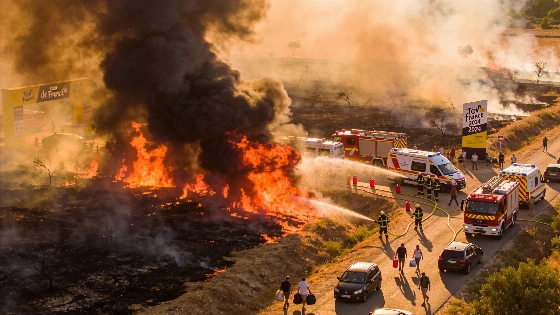
Southern France is facing a severe wildfire crisis after a blaze near Perpignan rapidly consumed 4,600 hectares and forced the evacuation of 10,000 residents. The fire, which broke out in the Trévillach massif about 30 kilometers west of Perpignan, remains uncontrolled despite the efforts of 700 firefighters. Five people have been injured, including two firefighters, as flames continue to threaten populated areas and critical infrastructure.
Authorities responded by ordering large-scale evacuations and deploying significant emergency resources. The prefect of Pyrénées-Orientales, Pierre Regnault de La Mothe, confirmed that one firefighter was injured when his vehicle was overtaken by flames, though he and his team managed to escape with minor injuries. The fire's proximity to Les Angles, where the third stage of the Tour de France is scheduled to finish, has led to unprecedented restrictions: the French segment of the race will proceed without spectators, and public access to the route is now strictly prohibited. Only cyclists and essential event vehicles are permitted in the area, following an official order from the prefecture.
Interior Minister Laurent Nuñez is set to visit the affected region to assess the situation and support emergency teams. He noted that this year's wildfire season has started earlier than usual, with the area burned already double that of the same period last summer. The European Commission has announced the deployment of four Bombardier firefighting aircraft to assist French crews in containing the flames.
The wildfire near Perpignan is the most severe among more than twenty active fires across southern France, which have together destroyed 11,000 hectares in recent days. Other significant blazes have been reported in Gard, where over 500 hectares have burned, and in Hérault, with 250 hectares lost. In Drôme, 450 hectares have been affected, and hundreds of firefighters are mobilized in Haute-Loire as fires continue to spread. The French government, represented by spokesperson Maud Bregeon, has described the situation as extremely worrying, emphasizing the full mobilization of state resources. President Emmanuel Macron has expressed solidarity with those impacted by the fires.
Officials had previously warned that the intense heatwave two weeks ago, which resulted in 2,000 deaths, would leave behind dangerously dry vegetation and strong winds—conditions ripe for wildfires. Currently, seven departments are under maximum fire risk alert, with 41 more on orange alert. Temperatures are expected to rise again this week, and 16 departments are now under heat surveillance. The impact on major events is notable: the Tour de France, a key sporting and tourism highlight, has had to adapt its organization in response to the emergency. This follows other recent disruptions in the region, such as the lockdowns in Catalonia due to wildfires, as reported in coverage of emergency measures during the La Bisbal d'Empordà fire.
France's early and intense wildfire season underscores the growing challenges posed by extreme weather and climate conditions. The combination of heatwaves, drought, and wind has created a volatile environment, putting pressure on emergency services and prompting authorities to implement strict safety measures. The ongoing situation is being closely monitored as temperatures are set to climb further, increasing the risk of new outbreaks and complicating containment efforts.