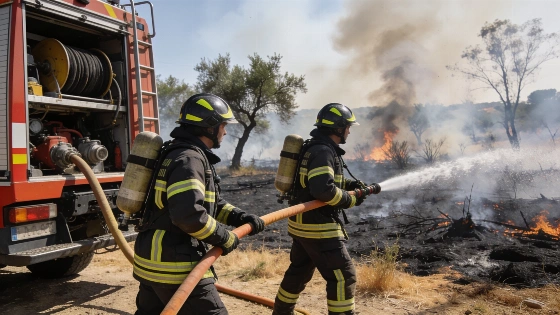
The wildfire in Niebla, Huelva, has exceeded 4,000 hectares. Over 300 personnel and 26 aircraft are battling the flames, but unpredictable winds are complicating containment. Key roads remain closed as authorities focus on critical fronts.
The wildfire in the Raboconejo area of Niebla (Huelva) has now affected more than 4,000 hectares, with authorities warning that shifting winds are making the situation increasingly volatile. Emergency services remain on high alert, maintaining operational phase 2 as the fire perimeter continues to expand and new fronts emerge due to sudden wind changes.
Antonio Sanz, head of the Plan de Emergencias por Incendios Forestales de Andalucía (Plan Infoca), explained that the wind is repeatedly forcing teams to adapt their strategy. The main focus this Saturday is on containing the northern flank and the head of the fire to the northeast, using heavy machinery, ground crews, and controlled burns. Aerial support is being deployed to prevent secondary outbreaks, while efforts also target the southern perimeter near the A-493 road and a firebreak north of the local recycling plant.
Authorities expect conditions to worsen after 14:00, when winds are forecast to shift to the southwest. Sanz emphasized the urgency of maximizing containment efforts before this change, as the wind could open new fronts and complicate the response further. Two main roads, the HU-3106 between Niebla and Valverde del Camino and the A-493, remain closed to traffic for safety reasons.
More than 300 personnel are involved in the operation, including 215 from Plan Infoca, 60 from the Unidad Militar de Emergencia (UME), and firefighters from the Huelva Provincial Consortium. The deployment includes 26 aircraft, 12 bulldozers—three from the UME—and a range of support vehicles and technical staff. On the ground, teams are using seven fire engines, seven heavy machines, 14 specialist firefighter groups, four BRICA units, and seven operations technicians, supported by logistics, environmental agents, and a mobile meteorology unit.
Two forest firefighters have required medical attention, with one remaining under observation at Hospital Juan Ramón Jiménez in Huelva, though reported to be stable and asymptomatic. The fire has forced the preventive evacuation of 70 people, most from second homes, with five needing hotel accommodation. The affected zones include Rabo-Conejo, Caballón, Tumbalejo, La Florida, and Las Arenas. No primary residences or lives are currently at risk, but authorities stress that no one should return to evacuated areas until officially permitted. The Guardia Civil intervened overnight to prevent unauthorized entry into the fire zone.
Since the first alert at 18:34 on Thursday, Emergencias 112 Andalucía has handled 240 calls related to the incident. No serious injuries have been reported. Sanz highlighted the scale of the machinery involved and praised the coordination among all agencies. He also urged the public to remain cautious and follow official instructions.
Wildfires remain a persistent threat in Spain, especially during periods of high temperatures and dry conditions. The Niebla incident follows a series of recent fire-related emergencies across the country, including the cancellation of public events in Madrid municipalities due to fire risk, as detailed in this report on local safety measures. These events underscore the ongoing challenges faced by emergency services and the importance of public cooperation during critical incidents.
Spain's wildfire response system, coordinated through regional and national agencies, is among the most advanced in Europe. However, the increasing frequency of extreme weather events continues to test resources and strategies. The situation in Niebla highlights the need for rapid adaptation and inter-agency collaboration, as well as the crucial role of timely public information and compliance with evacuation orders.