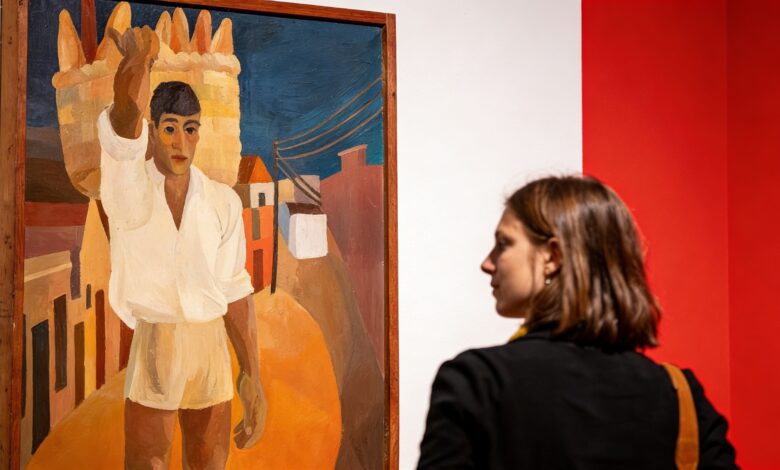
A major exhibition dedicated to the work of Esther Boix has opened in Barcelona, marking an important event for Spain’s cultural scene. The Espais Volart gallery showcases how the artist’s personal challenges and the social changes of the 20th century are reflected in her work. For Spaniards, it is not only a rare chance to see her pieces but also an opportunity to reflect on the role of women in art and how the past shapes modern values.
The path to change
The Vila Casas Foundation has brought together 180 works by Esther Boix to highlight her contribution to contemporary Catalan art. According to El Pais, the exhibition coincides with the centenary of the artist’s birth and emphasizes her social engagement, teaching career, and involvement in the anti-Franco movement. Boix was among those who, alongside her peers, opened new horizons for women in a field long considered male territory.
The exhibition traces the evolution of Boix’s outlook: from early works dominated by portraits and scenes of daily life to mature pieces focused on nature and ecology. Her artistic journey began with personal challenges—she contracted polio as a child, which influenced both her worldview and artistic style. Early paintings such as “Mi hermano” (1948) and “Mujer con silla” (1950) reveal keen observation and a quest for inner dialogue.
The influence of environment and society
During her student years, Boix met future like-minded colleagues: sculptor Josep Maria Subirachs and writer Ricard Creus. Together they founded the Postectura group, which advocated for honesty in art and the search for new forms. During this period, Boix experimented with Fauvism, as seen in works like “Músicos de jazz” (1951) and “El café” (1953). According to the exhibition curator, this was the time when Boix began to move away from academic traditions, striving for freedom of expression.
In the 1960s, Boix was an active participant in the Estampa Popular Catalana movement, where her works took on a distinctly social character. The painting “Mujer que friega” (1966) became a symbol of women’s struggle and reflected the realities of that era. During this same period, Boix faced repression: in 1966 she was detained during the events known as La Capuchinada, which influenced her art, filling it with protest energy.
Pedagogy and new horizons
Alongside her artistic work, Boix dedicated herself to teaching. In 1967 she and her colleagues founded L’ARC, a school focused on music, visual arts, and speech development. This project became a key milestone in shaping new educational approaches in Catalonia. The exhibition includes video interviews with former students, providing insight into Boix’s impact beyond the art world.
Over time, the artist’s work shifted toward nature. After Franco’s death and her move to the Garrotxa region, Boix increasingly turned to landscapes, depicting forests, fields, and rivers. During this period, human figures disappear as color and the forms of the surrounding world come to the fore. Series dedicated to La Fageda d’en Jordà and paintings such as “Desembocaduras” (1975), “Tormenta” (1981), and “Caminos ingrávidos” (1984) illustrate this stage.
Legacy and context
The exhibition concludes with the work “La nada y el hombre. Homenaje a Goya” (1996), where Boix reflects on humanity’s place in the universe, inspired by Goya’s famous piece “Perro semihundido.” This painting became a kind of summation of the artist’s personal and creative journey, intertwining her experiences with philosophical questions about existence.
In recent years, Catalonia has increasingly hosted exhibitions dedicated to women artists who previously remained in the shadows. For example, a clandestine tobacco factory was recently uncovered in the region, sparking broad public interest and becoming a topic of discussion on specialized platforms. Such events demonstrate how cultural and social processes are closely intertwined in contemporary Spain.
Reflecting on recent exhibitions, it is worth noting that interest in the legacy of 20th-century artists in Spain continues to grow. Museums in Barcelona and Girona regularly hold retrospectives dedicated to lesser-known artists whose works had previously not entered major collections. This leads to a rethinking of art history and broadens our understanding of women’s roles in the country’s cultural life.