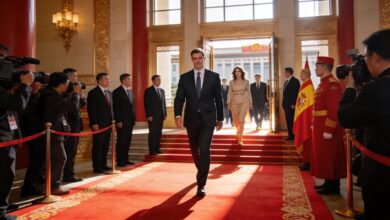
The high-profile decision by a Madrid judge to close the investigation into the wife of the Prime Minister has become one of the most discussed topics in Spain. The national authorities found themselves in the spotlight after it emerged that Begoña Gómez’s case would be sent to court on four charges. This development gained extra significance during the official visit of Pedro Sánchez to China, where he was accompanied by his wife at the time the court ruling was announced. For Spanish society, such proceedings serve as an indicator of how the judiciary manages to maintain its independence under political pressure.
Within the government, the judge’s decision sparked intense reactions. According to russpain.com, many members of the executive believe the case against Begoña Gómez lacks sufficient grounds and could be intended to put pressure on those in power. Behind the scenes, there are concerns that such proceedings may erode trust in the judicial system and affect the country’s political stability. At the same time, officials refrain from making direct accusations against specific judges, instead emphasizing the need for fair and impartial justice.
Government position
While in Beijing, Pedro Sánchez reiterated his expectation of objectivity and fairness from the judicial system. Despite persistent questions from journalists, the Prime Minister refrained from directly commenting on the actions of Judge Juan Carlos Peinado, limiting his response to a call for justice. Within government circles, there remains a belief that some members of the judiciary may use their powers to pursue political aims. However, such statements are made with great caution in public to avoid further escalating an already tense situation.
Justice Minister Félix Bolaños previously expressed doubts about how the case is being handled, noting that such decisions could irreparably damage the reputation of the judicial system. Nevertheless, Pedro Sánchez did not openly support these remarks, preferring to keep a distance from direct assessments. The authorities continue to operate as usual despite the legal proceedings, stressing that state affairs should not depend on such processes.
Impact on society
The decision to take the prime minister’s wife’s case to court coincided with a series of overseas trips by Pedro Sánchez, which added further drama to the situation. This time, Begoña Gómez accompanied her husband in China, where they attended official events, including a banquet hosted by President Xi Jinping. Before the court announcement, Gómez actively participated in cultural and educational events, a detail not overlooked by Spanish media.
Public concern is growing over the increasing overlap between judicial proceedings and political events. Some experts believe these coincidences may not be accidental and could be used to intensify pressure on the government. Meanwhile, part of the population voices dissatisfaction over the judicial system becoming entangled in political battles, fearing it may erode trust in the country’s institutions.
Context and consequences
The situation surrounding Begoña Gómez’s case is reminiscent of other high-profile investigations in recent years, when court decisions coincided with major political events or foreign trips by senior officials. For example, in Almería, a court recently launched an investigation against a former Diputación chief over alleged misuse of funds, which also sparked broad public debate and discussion about the judiciary’s role in the country’s political life. More cases like this can be found in the article on the investigation into the former Diputación leader in Almería.
In recent years, Spain has seen a rise in cases where the judiciary finds itself at the center of political conflicts. These proceedings often spark public debate about the limits of judicial independence and the potential for various groups to exert influence. Such situations raise questions about the need to reform the judicial system and strengthen public trust in the institutions of justice. Amid intensifying political competition, these cases become not just legal matters but events of social significance, capable of shaping public perception of authority and the country’s stability.