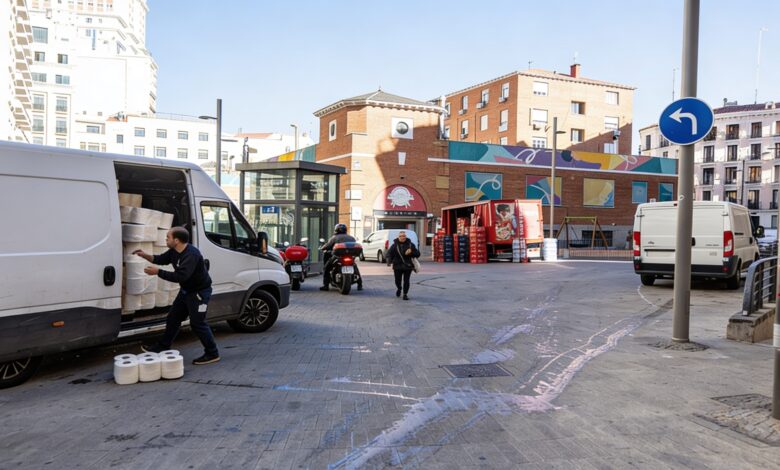
The large-scale renovation of Plaza de los Mostenses in central Madrid, completed in 2023 and costing the city three million euros, has not brought the expected changes. Despite the official announcement of a fully pedestrianized area, cars continue to freely enter the space, causing ongoing issues for pedestrians and residents of nearby buildings.
A ban that doesn’t work
In the morning, the square is filled with delivery vans, taxis, and private cars that ignore traffic signs and park right at the entrance to the market. According to local residents, there are neither loading zone markings nor any physical barriers to prevent access. As a result, even the children’s playground that appeared after the renovation is not protected from vehicles accidentally entering — parents are forced to constantly watch their children to prevent dangerous situations.
Residents’ and authorities’ responses
Residents note that the situation has only worsened since the renovation: previously, traffic was organized and clear, but now the boundaries between areas for cars and for pedestrians have disappeared. They say that appeals to the police and traffic officers yield no results — offenders are not fined, and the conflict between drivers and pedestrians has become part of everyday life. One concierge in a residential building said that taxis and services like Cabify regularly drive across the square, ignoring the restrictions.
City Hall’s position
Madrid City Hall admits that it has not been possible to completely eliminate cars, but claims that traffic flow has decreased. Authorities point to the availability of underground parking, which remains accessible, but residents are convinced that most vehicles use the square as a convenient shortcut through the Universidad district. In their view, order can only be restored by partially reverting to the previous traffic scheme, creating a separate loading zone, and fencing off the children’s playground.
Context and similar cases
Problems with implementing urban projects and conflicts between vehicles and pedestrians are not unique to Madrid. Other cities in Spain also experience disputes over infrastructure changes. For example, in Valencia, a conflict between the city council and the Ministry of Transport over the construction of a tunnel has dragged on, reflecting a general trend of difficulties when introducing new rules and restrictions. You can learn more about similar situations in the material covering the dispute over the Serrería tunnel: disagreements between the Valencia authorities and the Ministry of Transport.