A 16th-century wooden relief stolen from the Monasterio de Santa Clara in Fitero has been recovered by police. The artwork, missing for 16 years, was found in a Barcelona auction house. It has now been returned to its rightful owner.
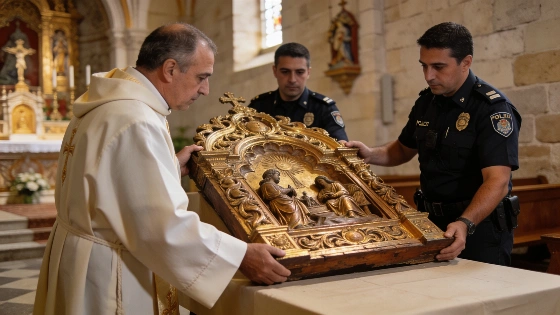
Spanish police have recovered a valuable 16th-century wooden relief that vanished from the Monasterio de Santa Clara in Fitero, Navarra, 16 years ago. The operation, led by Mossos d’Esquadra and the Policía Nacional, concluded with the return of the artwork to the Archdiocese of Pamplona and Tudela, the legal owner. The relief, which once adorned the main altar, depicts San Buenaventura and is attributed to the circle of sculptor Juan de Anchieta.
The investigation revealed a complex journey for the piece. After being stolen, the relief surfaced at Madrid’s Rastro market, passing through several hands before ending up in a Barcelona auction house. Police intervened just before it was due to be sold, tracing its provenance through a chain of buyers and sellers. The auction house had acquired the artwork from another individual, who in turn had purchased it from a different establishment. This meticulous tracking allowed authorities to confirm the relief’s identity and origin.
The recovered artwork measures 81 by 45.5 by 10 centimeters and features intricate carving, gilding, and polychrome details. Its historical and artistic value is significant, not only for the local community but also for Spain’s cultural heritage. The handover took place this Tuesday, with the parish priest of Fitero accepting the piece on behalf of the Archdiocese. The case highlights ongoing challenges in protecting religious and historical art from theft and illicit trade.
Spain has seen several high-profile recoveries of stolen art in recent years, reflecting increased cooperation between regional and national police forces. The return of the Fitero relief follows other notable discoveries, such as the unearthing of ancient Roman artifacts in Alicante, which also drew public attention to the issue of cultural property and its movement through unofficial channels. For example, the recent discovery of a Roman Venus head in Alicante sparked debate over the handling and protection of archaeological finds.
According to Spanish law, religious and historical artworks are protected as part of the nation’s heritage, and their theft is treated as a serious crime. The successful recovery of the Fitero relief underscores the importance of vigilance in the art market and the need for robust provenance checks by auction houses and collectors. The case also serves as a reminder of the enduring risks faced by religious institutions, many of which house irreplaceable works of art in often vulnerable settings. Efforts to improve security and documentation continue to be a priority for authorities and cultural organizations across Spain.