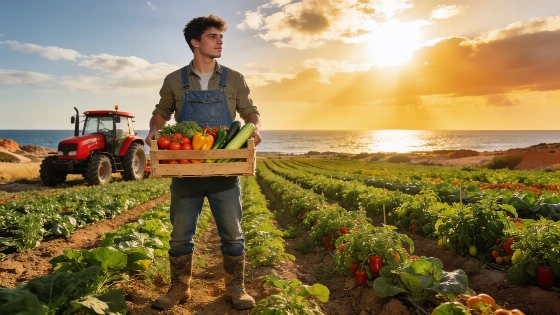
At just 22, Raúl García Vidal has transformed a single hectare into PenyaFresh, a fast-growing fruit and vegetable company in Alicante. His journey highlights the urgent labor shortages and lack of young talent threatening Spain’s agricultural future.
Raúl García Vidal, a 22-year-old from La Romana, is not the typical face of Spain’s next generation. While many of his peers leave rural life behind, García Vidal has built PenyaFresh, a dynamic fruit and vegetable company now spanning over 50 hectares between La Romana and Aspe. His story is a rare exception in a sector struggling to attract young talent and secure its future.
García Vidal’s path began at 17, when he moved into his mother’s country house and planted a single hectare of peppers and eggplants. Unlike many in the region, he did not inherit a family farming business—his background was limited to a few unprofitable almond plots. The early days were grueling: he worked through the night to prepare produce for morning sales at Mercalicante, handling nearly every task himself. These long, solitary hours laid the foundation for what would become a rapidly expanding enterprise.
Growth Through Grit
Driven more by passion than profit, García Vidal says, “I love getting on the tractor and spending 15 or 16 hours working the land.” That dedication has not gone unnoticed—he was recently awarded the ASAJA Alicante Young Farmer Prize for 2025, a recognition of both his entrepreneurial spirit and his commitment to the region’s agricultural renewal.
PenyaFresh now operates on two fronts. The first is the cultivation, marketing, and export of its own produce, including vegetables, stone fruits, and watermelons. The second is providing agricultural services to landowners who can no longer—or no longer wish to—work their fields. This dual approach allows the company to maintain year-round activity and offer greater job stability, a rarity in a sector often defined by seasonal peaks and uncertainty.
Labor Shortages and Structural Hurdles
Despite his success, García Vidal is candid about the challenges facing Spanish agriculture. He points to two critical issues: a shrinking labor pool and a lack of professionalization. “Fewer people are willing to take on the tough realities of farm work,” he notes, a trend that threatens the viability of many operations across Alicante and beyond.
Medium-sized businesses like PenyaFresh face additional obstacles. They shoulder heavy administrative burdens but lack the resources and market access of larger corporations. This imbalance is felt in everything from supply costs to hiring specialized staff. As highlighted by ASAJA Alicante, these pressures are compounded by broader sectoral problems—water scarcity, pests, rising production costs, foreign competition, and declining profitability.
Innovation and Heritage
While García Vidal’s story is one of rare upward mobility, it also echoes a wider debate about the future of Spanish agriculture. The struggle to attract young people to the land is not unique to Alicante. Across Spain, efforts to revive traditional crops and farming methods—such as the recent project to restore a historic Soria tomato variety, detailed in this report on reviving century-old tomato seeds in Palencia—reflect a growing awareness of the need to balance innovation with heritage.
For now, PenyaFresh stands as a testament to what is possible when determination meets opportunity. Yet García Vidal’s experience also serves as a warning: without new generations willing to take up the challenge, the future of Spain’s fields remains uncertain.