Farmers in Lopera demand a halt to solar plant licenses on agricultural land. Vox supports the protest but avoids direct conflict with the Junta. The issue tests the PP-Vox coalition and local governance.
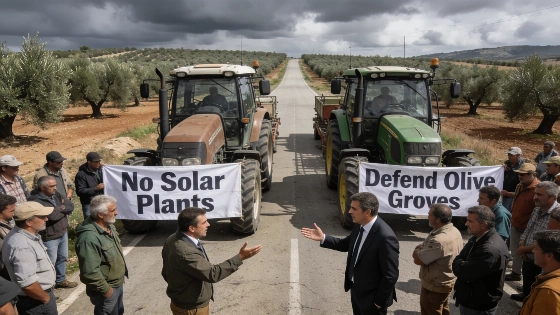
Pressure is mounting on the Andalusian government as a coalition of farmers, local officials, and political groups challenge the expansion of large-scale solar plants on productive farmland in Jaén. On Tuesday, around 200 farmers in Lopera staged a tractor protest, demanding the immediate suspension of licenses for four planned photovoltaic projects in the area. The demonstration, organized by the Campiña Norte platform, has exposed growing friction within the regional government, particularly between the Partido Popular (PP) and its coalition partner Vox.
Vox, which has consistently opposed the installation of renewable energy plants on agricultural land, joined the protest but carefully avoided direct confrontation with the Junta de Andalucía. Instead, the party directed its criticism at the local socialist-led council, urging it to freeze all urban planning licenses for solar installations. Meanwhile, Lopera’s mayor, Carmen Torres, called on the Junta to take responsibility for suspending the projects or, at minimum, to provide the legal certainty needed for the municipality to act on its own.
The coalition agreement between PP and Vox in Andalucía includes a specific measure—at Vox’s insistence—banning renewable energy plants on farmland. This issue has become especially contentious in Jaén, where seven major solar projects are planned across Lopera, Arjona, and Marmolejo, with a combined capacity of 310 megawatts. According to the Campiña Norte platform, these developments could lead to the removal of thousands of olive trees, a concern that has galvanized local opposition.
During the protest, Vox’s only councilor in Lopera, Martín Valenzuela, emphasized that the responsibility now lies with the local council. Several groups aligned with Vox, including SOS Rural and Ecología y Libertad, have taken legal action, arguing that the projects were artificially fragmented to bypass regulations. A court in Andújar has admitted a criminal complaint on these grounds, citing potential harm to farmers whose land was expropriated. The platform has appealed the dismissal of this case, while Ecología y Libertad has filed a separate administrative challenge against the Junta’s energy and industry department, seeking to annul the sectoral permits underpinning the municipal licenses.
The Campiña Norte platform is also pressing the council to approve a special urban plan that would allow for the suspension of all licenses related to solar energy projects, including those already submitted or pending. They argue that previous council resolutions and institutional declarations support this move, and that the law provides for compensation to affected companies if licenses are revoked in the public interest.
Mayor Carmen Torres has formally requested urgent intervention from Manuel Gavira, the second vice president of the Junta and Vox’s leader in Andalucía. In her letter, she asks the regional government to either halt the projects or ensure the municipality has the legal tools to do so. Torres points to the coalition agreement’s commitment to protect productive farmland and require binding agricultural impact reports for renewable energy projects. She warns that suspending licenses at an advanced stage could expose the municipality to significant financial liabilities, underscoring the need for the Junta to take the lead, especially since the regional administration granted the initial authorizations.
This dispute comes amid broader concerns in Andalucía about land use, economic priorities, and the balance between renewable energy expansion and agricultural preservation. The region has seen similar tensions in other policy areas, such as the housing market, where rising rents and property prices have shifted public priorities, as highlighted in a recent report on the growing housing crisis in Andalucía. The current standoff over solar projects reflects the complex interplay between environmental goals, local livelihoods, and political alliances in the region.
Andalucía is a national leader in renewable energy production, but the rapid deployment of large-scale solar and wind projects has sparked debate over their impact on rural communities and traditional agriculture. The outcome of the Lopera dispute could set a precedent for how similar conflicts are managed across Spain, especially as the country pursues ambitious climate and energy targets. For now, the issue remains unresolved, with local authorities, regional leaders, and national parties all under pressure to find a solution that balances economic, environmental, and social interests.