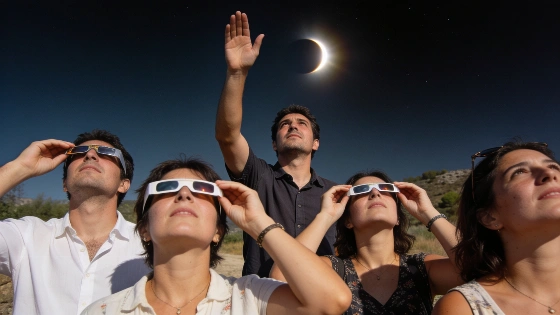
During a total solar eclipse, only a brief window allows safe viewing without protection. Experts stress a strict ritual to avoid eye injury. The risk rises if glasses are removed too early or too late.
During the fleeting phase of a total solar eclipse, astronomers warn that only a precise ritual can guarantee safe viewing. As the Sun’s disk vanishes completely, it becomes briefly safe to look directly at the sky without protective glasses. This moment, lasting about a minute, is the only time when the Sun’s corona—a white halo surrounding a blackened Sun—can be seen with the naked eye. According to guidance from the Sociedad Astronómica de EE UU, the corona shines with a brightness similar to a full Moon, making it safe to observe for a short period.
However, the risk of eye damage remains high if glasses are removed even seconds before totality or not replaced immediately as the Sun’s rays reappear. Experts consulted by EL PAÍS emphasize that failing to follow the correct sequence means missing the most spectacular part of the eclipse or, worse, exposing eyes to dangerous solar radiation. The danger is greatest at the end of totality, when pupils are dilated and the first rays of sunlight return.
To address these risks, astronomers have established a group ritual for eclipse viewing. One person acts as a guide, announcing each step aloud—much like the tradition of eating grapes at New Year’s. This ensures everyone removes and replaces their glasses at the correct moments, minimizing confusion and preventing accidents. Jorge Pérez Gallego, director of communication and outreach at the US National Solar Observatory, coordinated the scientific broadcast for the 2024 eclipse and highlights the importance of this coordinated approach.
Strict safety protocols have become standard at public eclipse events in Spain and abroad. As noted in a recent report on the strict rules for eclipse viewing in Spain, even a brief lapse in protection can cause lasting eye injury. Organizers now routinely appoint a designated announcer to guide groups through the critical phases, echoing the recommendations of international astronomical societies.
For context, total solar eclipses are rare events in any given location, often separated by decades. The brief period of totality is the only opportunity for the public to witness the Sun’s corona without risk, provided all safety measures are followed. The ritualized approach, now widely adopted, reflects both the popularity of eclipse gatherings and the need for clear, collective action to prevent harm. As Spain prepares for future astronomical events, these protocols are expected to remain a central part of public guidance, ensuring that the spectacle can be enjoyed safely by all.