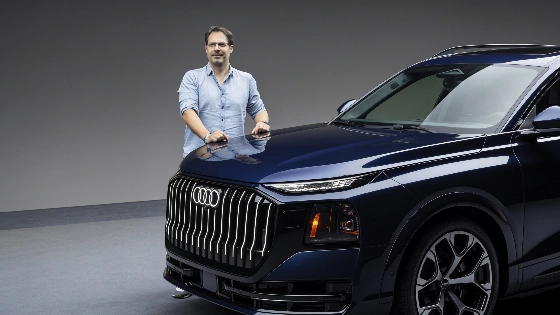
Audi has unveiled the Q9, its most imposing SUV to date. With up to seven seats, a 299 hp V6 diesel, advanced digital lighting, and a starting price of €126,000, the Q9 targets the top tier of the premium SUV market.
Measuring 5.31 meters in length and 2.21 meters wide, the new Audi Q9 immediately stands out as the largest SUV ever produced by the brand. Designed to push Audi’s range into new luxury territory, the Q9 combines sheer size with a focus on comfort, technology, and high-end materials.
The exterior design borrows cues from the latest Audi Q7, but amplifies them. The upright Singleframe grille dominates the front, flanked by integrated headlights and a sculpted bonnet. Along the sides, the Q9’s proportions are unmistakable, with a high beltline and a rear profile that avoids the coupe trend in favor of maximum space. Wheel options reach up to 23 inches, underlining the car’s presence.
At the rear, Audi introduces a world-first: third-generation curved digital OLED taillights. These lights use 512 segments across six panels, improving lateral visibility and allowing for dynamic lighting signatures. Audi’s expertise in automotive lighting is on full display here, setting a new standard for the segment.
Interior Space and Technology
Inside, the Q9 is engineered for both families and executives. Standard configuration offers seven seats, with an optional six-seat layout featuring individual business-class chairs in the second row. All three seats in the second row come with Isofix mounts, making the Q9 especially practical for larger families.
Access to the rear is made easier by electrically operated doors that open up to nearly 90 degrees. These doors feature obstacle detection and can be controlled from multiple points, including the myAudi app, though this adds technical complexity.
The panoramic roof is the largest ever fitted to an Audi, covering over 1.5 square meters. It features adjustable transparency across nine segments and 84 LEDs, creating a customizable ambient experience. Materials throughout the cabin include wool, alpaca fiber, Dinamica microfiber, synthetic leather, Nappa leather, and natural wood, with a deliberate reduction in glossy surfaces for a more refined look.
Digitalization is central to the Q9’s interior. The curved MMI panoramic display integrates an 11.9-inch instrument cluster and a 14.5-inch central touchscreen, while the front passenger gets a dedicated 12.3-inch display. The infotainment system runs on Android Automotive OS, with an integrated app store and the Audi assistant, which now supports natural language and ChatGPT integration for vehicle functions, navigation, and weather updates.
Convenience features include dual wireless charging pads (Qi 2.2 compatible), USB-C ports delivering up to 60 watts in the second row and 100 watts in the third, and a luggage area equipped with aluminum rails, sliding hooks, and adjustable anchors for securing cargo.
Performance and Safety
At launch, the Q9 is powered by a 3.0-liter V6 TDI engine producing 299 hp and 630 Nm of torque. The mild-hybrid MHEV plus system can add up to 24 hp and 370 Nm in specific situations, while an electric compressor delivers 7.5 kW and up to 3.6 bar of boost in just 1.2 seconds. Power is sent through an eight-speed tiptronic transmission to Audi’s quattro all-wheel drive system.
Adaptive air suspension comes standard, offering 90 mm of total adjustment and the ability to lower the body by up to 62 mm from the balanced mode. Four-wheel steering allows the rear wheels to turn up to five degrees, improving maneuverability despite the Q9’s considerable size.
Safety features include automatic emergency braking, pedestrian and cyclist detection, blind spot monitoring, rear cross-traffic alert, 360-degree cameras, parking assistance, trailer functions, and emergency assist.
Positioning and Market Context
The Audi Q9 will be built in Bratislava, with orders open now and first deliveries expected in November. Pricing starts at approximately €126,000, but with options and higher trims, the total can exceed €140,000. This positions the Q9 directly against the most exclusive premium SUVs, offering a blend of space, technology, and luxury that few rivals can match.
For those interested in how other brands are redefining the high-performance SUV segment, a recent review of the Porsche 911 GT3 Touring highlights the ongoing evolution of luxury and driving dynamics in today’s market. Read more in this analysis of the GT3 Touring’s appeal.
As the flagship of Audi’s SUV lineup, the Q9 signals the brand’s ambition to compete at the very top of the luxury market. Its combination of advanced features, spaciousness, and refined engineering reflects a growing demand for vehicles that deliver both comfort and cutting-edge technology. The Q9’s arrival may also prompt other premium manufacturers to rethink their own offerings in this competitive segment.