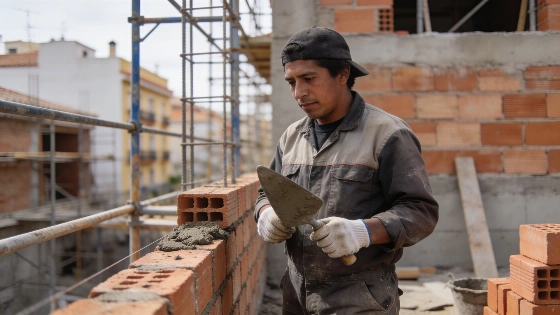
A Bolivian construction worker living in Spain says his monthly pay is over three times higher than what he could earn in Bolivia. His story highlights the wage differences, the realities of the Spanish labor market, and why many skilled migrants are drawn to the sector.
Albino, a Bolivian bricklayer now based in Spain, puts numbers to a reality many migrant workers know well: the pay for his trade in Spain can reach €1,300 to €1,400 a month, while in Bolivia, the same job typically brings in just €400. Both countries expect eight-hour workdays, but the financial gap is hard to ignore.
His comments, first made in an interview that resurfaced in July 2026, have sparked renewed interest as Spain’s construction sector faces a severe labor shortage. Albino’s experience is personal, not a universal benchmark—he did not specify whether his figures were gross or net, how many annual payments he received, or which province he worked in. In Spain, construction wages depend on local agreements, job category, and extra payments, making direct comparisons tricky.
From Bolivia to Spanish Building Sites
Albino arrived in Spain six years ago, entering construction at age 25 with help from a cousin already in the trade. He admits he started with little experience, learning the craft on the job. Adjusting to Spain’s wider range of materials and techniques was a challenge, but he now manages entire projects and says he has spent nearly half his life in the industry.
Wages: More Than Just Numbers
Based on Albino’s estimates, a Spanish bricklayer’s monthly income is roughly 3.25 to 3.5 times higher than in Bolivia. However, the real picture is more complex. The 2026 national minimum wage in Spain stands at €1,221 gross per month (in 14 payments), or €17,094 annually. Depending on whether Albino’s figures refer to 12 or 14 payments, his annual earnings could range from €15,600 to €19,600—sometimes above, sometimes below the minimum, depending on the specifics.
Spanish construction salaries are set by provincial agreements, with the latest sector-wide deal mandating a 3% increase for 2026. This means there is no single national wage for bricklayers; pay varies by region, job level, and contract terms. Without knowing Albino’s exact circumstances, it’s impossible to say if his pay was above or below the local standard.
Labor Shortages and Migration
The construction industry in Spain is facing a critical shortage of workers. The National Construction Confederation estimates that 700,000 new employees are needed, and regularizing migrant labor is seen as part of the solution. The sector’s aging workforce is a major factor: workers under 29 made up just 9.2% of the industry in 2022, down from 25.2% in 2008. As fewer young Spaniards enter the field, experienced migrants like Albino are increasingly vital.
Stories like Albino’s echo those of other foreign workers who find better pay and more stable conditions in Spain. The wage gap is a powerful draw, especially for those with skills and experience. For comparison, a young Madrid priest recently revealed that his church salary is even lower than the national minimum wage, showing how pay can vary widely across sectors and roles (see how a Madrid priest manages on less than minimum wage).
Personal Testimony, Not a Universal Rule
Albino’s account is a snapshot, not a definitive guide to construction pay in Spain. His experience highlights the opportunities and challenges facing migrant workers, as well as the complexities of Spain’s wage system. For anyone considering a move or a career in construction, the details—location, contract, and category—matter as much as the headline numbers.