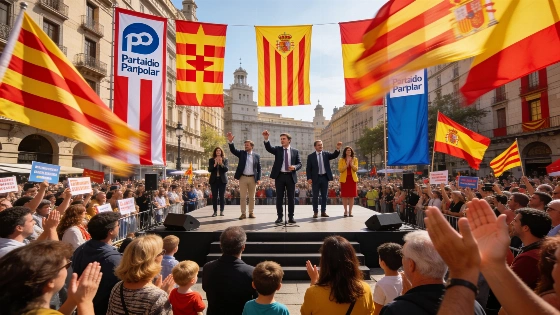
The Catalan PP is reshaping its leadership and strategy to expand its presence. The party aims to close the gap with PSOE and secure more seats in the next general election. Feijóo’s national ambitions hinge on stronger results in Catalonia.
The Catalan branch of the Partido Popular (PP) has launched a renewed campaign to expand its influence across the region, aiming to play a decisive role in the 2027 general elections. With the memory of the 2023 defeat still fresh—when the PSOE secured 19 seats in Catalonia compared to the PP’s 6—the party is determined to avoid a repeat scenario that allowed Pedro Sánchez to form a majority in Congress.
At the heart of this new approach is a clear ambition: to become the “Casa Gran de la Cataluña real,” echoing the strategy once used by Convergència to broaden its appeal beyond traditional bases. The phrase, now adopted by the new Catalan PP secretary general Juan Fernández, signals a shift toward engaging a wider spectrum of voters disillusioned with the legacy of the procés and the current socialist leadership.
Leadership changes have been central to this transformation. Lorena Roldán, closely aligned with outgoing leader Alejandro Fernández, will take over as spokesperson in the Catalan Parliament. This move is seen as an effort to unify the party after years of internal friction and to ensure that the regional leadership is fully aligned with Alberto Núñez Feijóo’s national objectives.
The PP’s strategy focuses on strengthening its territorial presence, with plans to increase activity in every comarca and municipality. The party believes that by addressing what it calls the “real problems” of Catalans—such as economic stagnation and dissatisfaction with the aftermath of the independence movement—it can attract voters who are “tired of socialism and decline.”
Party insiders describe Feijóo’s approach as pragmatic, emphasizing that electoral support is the key to influence within the party. The leadership is determined to replicate the success of José María Aznar’s 2000 campaign, when the PP achieved its best-ever result in Catalonia with 12 seats. With the rise of Vox and Aliança Catalana in recent polls, the PP is also working to protect its electoral space from further fragmentation on the right.
As the party prepares for upcoming municipal and general elections, it is betting on a message of unity and renewal. The leadership argues that Salvador Illa, the current socialist leader in Catalonia, may face growing challenges due to his close ties to Sánchez and ongoing controversies. Meanwhile, Junts is still redefining its ideological stance, and ERC is seen as representing a phase that many Catalans want to move beyond.
This recalibration in Catalonia comes amid broader national tensions, as highlighted by recent calls from Junts for Sánchez to step down to prevent a far-right government—a development covered in detail in recent political analysis. The PP’s leadership sees the current moment as an opportunity to position itself as the main alternative for voters seeking change.
For context, Catalonia has long been a challenging region for the PP, with its best results historically falling short of those in other parts of Spain. The party’s new strategy reflects a recognition that national success in 2027 will depend heavily on its ability to gain ground in this key region. By focusing on local issues and presenting itself as a credible alternative to both the left and the remnants of the independence movement, the PP hopes to reshape the political landscape ahead of the next electoral cycle.