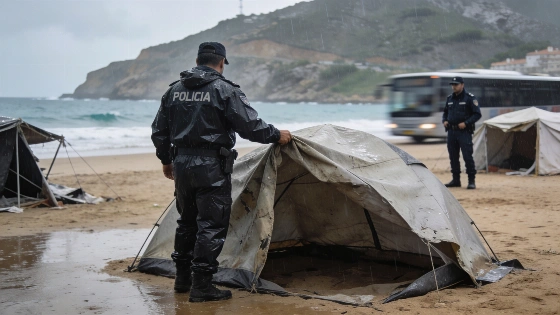
Police are dismantling Ceuta's largest migrant settlement days before Spain's King and Queen visit the city. Nearly 3,000 people were initially reported to be living there, while police say the camp holds more than 3,500.
Rain began at about 8:30am as police moved into the Trampolín beach settlement in Ceuta. The camp had shown ordinary signs of life earlier that morning. Music played, people sold goods, and residents woke up.
Police began dismantling the site after more than two months of harsh living conditions. The initial description put the population at nearly 3,000 people. The Jefatura Superior later said more than 3,500 people were living there. Authorities cited contaminated water and the lack of safe conditions as public health risks. EFE and Europa Press reported that the settlement had also become a sanitation and public-order concern.
The camp is being cleared in stages. Sunday's operation covers only the first phase, according to the Jefatura Superior. The government has set 15 October as the deadline for completing the clearance. The royal visit is scheduled for 13 October.
AFP reports that the trip will be the first visit by a reigning Spanish monarch to Ceuta since 2007. The immediate goal is to remove the tents and move residents into available facilities.
The first phase is focused on the section of Trampolín next to the desalination plant, known locally as the desalinizadora.
The first phase focuses on the part of Trampolín beside the desalination plant, known locally as the desalinizadora.
Units from the UIP arrived from Seville, Granada, Málaga and other parts of Spain. The UPR also joined them, along with Information officers from Ceuta and elsewhere. Police closed every access route to stop people moving towards the hills and to reduce the risk of clashes inside or near the camp. A drone watched the area from above. Vehicles brought from mainland Spain added to the deployment.
The security detail included two BMR armoured vehicles and a Vamtac S3 all-terrain vehicle. Local police announced traffic restrictions from about 7:30am on roads linking Benítez and Benzú. The first National Police van reached the site shortly after that time. The deployment began at about eight.
Some residents ran towards the hills as tension rose. The site was tense. Women and children were among those moved in the first phase, although most residents were men.
Reports described a deployment of more than 30 police vans, including UIP units, while access roads were blocked to limit movement towards the hills and reduce the risk of clashes. The operation was conducted amid heightened tension after a migrant was detained the previous day following an alleged confrontation with officers involving large stones on Trampolín beach.
Officers went from tent to tent and from one makeshift shelter to the next. They told residents they had to leave while the structures were removed. An interpreter gave instructions in Arabic about the destinations.
The first bus left shortly before 9am, Radio Televisión Ceuta reported. The people being transferred are taken to the CATE at El Tarajal, the Centro de Atención Temporal de Extranjeros, for initial screening and registration. Some may choose to return to their countries of origin. Several people displaced from Benítez did so earlier in the week.
Accommodation is the main constraint. Loma Colmenar has space for more than 1,000 people. The port has additional places. Even so, the shortage has already pushed people back towards the beaches. In mid-September, the port camp was planned for 1,700 residents. More than 2,000 people were left outside and returned to the shoreline.
The two earlier operations in Benítez make Trampolín the third clearance effort in only a few weeks. Ceuta has already seen this cycle. Clearance is followed by displacement.
More than 70,000 people arrived from Morocco at the end of July. Most were returned within hours. The scale of that movement, along with the repeated return of displaced residents to the beaches, shows why removing tents alone cannot settle the problem. The account of Madrid's camp offers a separate example of how quickly an improvised settlement can become a visible housing and public-order issue.
Ceuta's operation addresses an unsafe site with contaminated water. It does not solve the wider problem. Until there are enough places for everyone removed from the beach, the same cycle may continue. Police have begun the clearance. The shortage of accommodation remains unresolved.