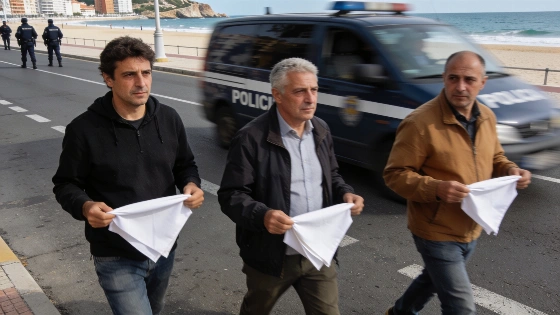
More than 200 people marched toward El Tarajal in Ceuta. Residents called for stronger border protection and the resignation of the Government delegate.
More than 200 people set off for El Tarajal beach in Ceuta under police escort, with military personnel nearby. The march turned the migration crisis into a direct demand for stronger border protection. Protesters also renewed calls for the Government delegate's dismissal. The demonstration came as authorities were still dealing with thousands of people who crossed from Morocco during the mass border breach at the end of July.
The march began around noon at the Juan Carlos I esplanade. The site is three kilometres from the Moroccan border. People gathered with flags of Ceuta, Spain and Europe before heading toward the shoreline. Estimates of the number of migrants still in Ceuta varied. Reuters and the BBC reported roughly 10,000 to 12,000 people, while local sources cited as many as 13,000.
The Spanish government said that 5,321 people had voluntarily returned to Morocco since 10 August. A further 90 people had withdrawn asylum applications, while about 1,000 were being registered for return.
The Federation Provincial de Asociaciones de Vecinos (FPAV) organised the protest and planned to read a manifesto at El Tarajal. Its stated aim was to defend Ceuta's border. Marchers gathered behind a Spanish flag carrying the message «SOS Ceuta invadida».
The political target was clear. Participants shouted «delegado, dimisión» and «Tirano, canalla, tú no eres caballa». The chants referred to the Government delegate, whose removal residents have demanded at protests since the crisis began.
Several National Police vans and military personnel accompanied the procession from the esplanade toward the beach. A motorbike gathering was also scheduled to follow a route that would converge on the Tarajal border crossing.
The march followed a wider security and relocation operation. On 18 September, Spanish police began clearing migrants from Ceuta's beaches and moving them to a new tented facility with capacity for 1,700 people. Reuters reported that officers used batons and fired rubber bullets into the air to control the situation.
On 17 September, the European Parliament adopted an amendment condemning the mass crossing into Ceuta at the end of July and called for a full independent investigation into the circumstances of the incident. The demand placed the border crisis on the European parliamentary agenda as well as within Spain’s domestic political debate.
The march added a public protest to the pressure already building around Ceuta's border and beaches. Residents had earlier taken a symbolic beach settlement to the Government headquarters, as documented in an earlier report. This time, the protesters put the border itself at the centre of the action.
Spanish authorities were also expanding temporary accommodation. The Ministry of Migration announced 864 additional places. That brought the total to about 4,300, with plans to raise capacity to 6,000.
People were still being moved from beaches and streets to temporary centres in the port. The competing estimates of the remaining population showed how far the available infrastructure fell short of the scale of the crisis.
The protest had one clear demand: strengthen Ceuta's border and remove the Government delegate. The FPAV manifesto and the motorbike gathering broadened the event, while the police and military escort showed how sensitive the route was. Residents carried local, national and European flags toward El Tarajal. For those taking part, migration had become a direct political and security issue.
The crisis has also reached the European political debate. On 18 September, EU migration commissioner Magnus Brunner linked images from Ceuta to growing support for far-right parties and calls for a tougher migration policy.