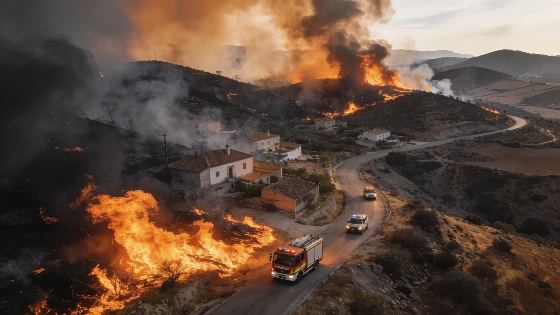
The Los Gallardos wildfire exposed critical gaps in Spain’s emergency alert system. Authorities chose door-to-door warnings over Es-Alert, citing technical limits. Rural areas remain at risk as technology lags behind real needs.
The wildfire that erupted in Los Gallardos, Almería, has become the deadliest in Andalusia in recent years, with at least 12 fatalities and 23 people still missing. The rapid advance of the flames, reportedly triggered by a snapped cable near a main road, turned the region’s scattered homes and rural retreats into a deadly trap. The fire’s speed—reaching up to 100 meters per minute—left little time for coordinated evacuations, especially in an area where population centers are widely dispersed and access routes vary in safety.
Emergency authorities faced a critical decision: whether to use the national Es-Alert mobile warning system or rely on traditional, direct communication. Officials from the Junta de Andalucía ultimately opted against sending a mass alert, arguing that the technology cannot target messages to small, specific groups. Instead, police, volunteers, and the Guardia Civil went door-to-door, warning residents individually. According to the regional emergency agency, Es-Alert messages are broadcast to everyone connected to a given antenna, making it impossible to differentiate between those who should shelter in place and those who must evacuate. This limitation, they said, could have caused confusion or even put more lives at risk.
Experts in emergency management and geosciences agree that Es-Alert, while effective for broad warnings, is not yet capable of delivering tailored instructions in rural or fragmented areas. The system’s coverage is determined by radio repeaters, and current technology does not allow for precise targeting within small perimeters. As Jesús Miranda from the University of Málaga explains, the system’s reach is still too broad to distinguish between neighboring zones that require different responses. Alonso Chaves, a geologist at the University of Huelva, is researching how emergency communications can be adapted when a single event demands multiple, sometimes conflicting, instructions for nearby residents.
Technical challenges were compounded by the fire itself, which damaged telecommunications infrastructure and left some communities without mobile coverage. The government cited reports from Telefónica confirming that many communication posts were destroyed, further limiting the effectiveness of any digital alert. In such conditions, the density and placement of radio antennas become critical, and in rural Andalusia, these are often too sparse to guarantee full coverage.
In the absence of reliable technology, authorities turned to methods that have served rural Spain for generations. The ringing of church bells and door-to-door warnings proved more effective than digital alerts in reaching isolated residents. The national Civil Protection agency itself notes that Es-Alert is meant to complement, not replace, traditional warning systems like sirens and loudspeakers. Researchers are now exploring ways to integrate new technologies, such as drones equipped with loudspeakers, to improve emergency communication in hard-to-reach areas.
Prevention, rather than just alerting, is emerging as a key priority for regions with complex terrain and scattered housing. Experts argue that emergency plans must be tailored to local conditions, with a focus on self-protection and adaptation to climate and geography. The Los Gallardos tragedy has reignited debate over the proliferation of isolated homes in forested areas—a trend that complicates both evacuation and firefighting efforts. As noted by specialists in geography and land management, the spread of vacation homes into wooded zones increases the risk of both starting and suffering from wildfires, especially as climate change accelerates the speed and unpredictability of such disasters.
This incident is not isolated. In a related event, a previous wildfire in Los Gallardos led to multiple deaths after residents took a dead-end escape route, highlighting the persistent dangers faced by those living in rural, hard-to-access locations. The combination of outdated warning systems, infrastructure vulnerabilities, and changing land use patterns continues to challenge Spain’s ability to protect its most vulnerable communities during emergencies.
Spain’s experience with wildfires underscores the urgent need for both technological innovation and practical, community-based solutions. While Es-Alert remains the best available tool for mass notification, its current limitations leave rural populations exposed. Until more precise and resilient systems are developed, traditional methods and local knowledge will remain essential in safeguarding lives during fast-moving disasters.