The EU, Spain, the UK, and Gibraltar have finalized an agreement to dismantle the border fence. The deal ends physical checks and introduces joint controls at the airport and port. Daily life for thousands of cross-border workers will change.
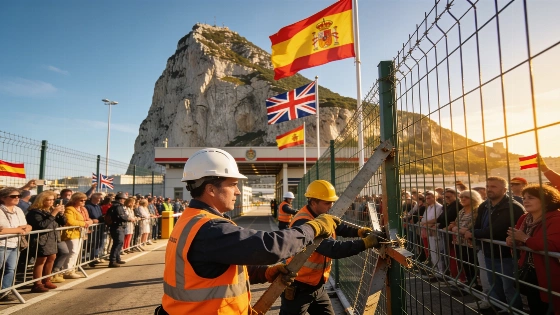
The European Union and the United Kingdom have formally signed an agreement that brings an end to the border fence separating Gibraltar from La Línea de la Concepción. The deal, which enters into force on July 15, eliminates the last major unresolved issue from Brexit negotiations and marks a turning point for the region. With the removal of the historic barrier, physical checks at the land border will cease, and a new system of dual controls will be implemented at Gibraltar’s airport and port.
The agreement was signed in Brussels by Maros Sefcovic, the European Commissioner for Interinstitutional Relations, and Stephen Doughty, the UK Secretary of State for European Affairs. The ceremony was attended by Spain’s Foreign Minister, José Manuel Albares, and Gibraltar’s Chief Minister, Fabian Picardo. The move follows more than a year of technical work after a political consensus was reached, and it is seen as the final piece in the complex Brexit puzzle.
For residents and workers in the Campo de Gibraltar, the disappearance of the fence is a significant development. Thousands of Spanish citizens who cross daily for work will now benefit from the absence of physical barriers, streamlining their commute and reducing delays. The new arrangement introduces a model similar to the one used at London’s Saint Pancras station, where French police conduct checks on trains bound for Brussels and Paris. In Gibraltar’s case, Spain will carry out full Schengen controls at the airport and port, while Gibraltar authorities will maintain their own checks on the UK side.
Spanish Foreign Minister Albares described the agreement as historic, emphasizing that it opens a new era for Gibraltar and the surrounding region. He highlighted the potential for increased cooperation and economic opportunity, noting that after three centuries, Gibraltar and the Campo de Gibraltar will be able to reconnect without physical barriers. According to Albares, the deal not only resolves the last outstanding Brexit issue but also strengthens bilateral relations between Spain and the UK, as well as ties between the EU and the UK.
The Brexit referendum in June 2016 reignited the long-standing dispute over Gibraltar, which had remained largely dormant since Spain joined the EU. While previous negotiations managed to address contentious issues such as Northern Ireland, the future of Gibraltar’s border remained unresolved until now. The new agreement is expected to have a direct impact on cross-border movement, trade, and daily life for both communities.
As the last physical barrier on continental Europe is dismantled, the region prepares for a new phase of cooperation. The changes are expected to benefit not only workers and residents but also travelers and businesses operating in the area. For additional context on the historical significance of the border’s removal and its impact on local communities, see this detailed report on how the demolition of Gibraltar’s fence is transforming daily life: the story of the fence’s demolition and its effects on both sides.
Gibraltar, a British Overseas Territory located at the southern tip of the Iberian Peninsula, has long been a point of contention between Spain and the UK. The border fence, first erected in the 20th century and closed for years under Franco, symbolized decades of division. Its removal now signals a shift toward greater integration and cooperation, with new controls designed to balance security and freedom of movement. The agreement is expected to serve as a model for managing borders in other sensitive regions, reflecting the evolving relationship between the EU and the UK in the post-Brexit era.