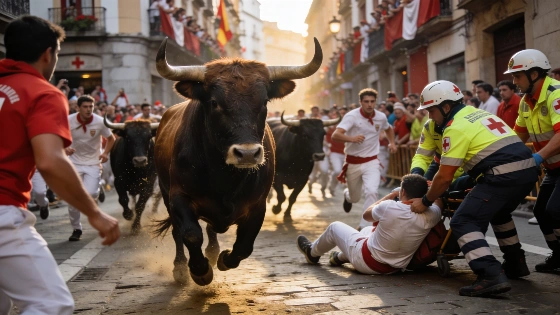
The fifth running of the bulls at San Fermín 2026 saw 14 runners injured. One suffered a goring, while others were treated for bruises. Emergency services responded quickly amid a tense and crowded event.
The fifth encierro of San Fermín 2026 in Pamplona ended with 14 runners requiring medical attention, highlighting the risks that persist despite years of experience managing the event. Emergency teams reported that six people were taken to the Hospital Universitario de Navarra, including one with a goring injury and five with various contusions. Four additional runners were transferred to local clinics for further care, while another four received treatment for bruises directly in the bullring.
This morning's run was marked by heightened tension from the outset. The encierro lasted just 2 minutes and 36 seconds, but the pace was relentless. Early in the race, a single bull broke away from the herd, creating chaos and leading to several dangerous moments. The density of runners on the course added to the complexity, making it difficult for participants to maneuver safely and increasing the risk of injury.
Medical officials confirmed that nine runners required transport to medical facilities, with one case involving a goring. The remaining injuries were primarily contusions, a common outcome in such high-adrenaline events. The provisional medical report underscores the ongoing challenge of ensuring safety during the festival, especially as crowds continue to swell each year.
As tradition dictates, runners gathered before dawn to sing to San Fermín, seeking protection before the start. The chant, performed three times before the run, has evolved since 2009 to include both Spanish and Basque verses, reflecting the region's linguistic heritage. The lyrics ask the patron saint for guidance and blessing during the dangerous dash through Pamplona's streets.
This year's fifth encierro featured bulls from the José Escolar ranch, known for their imposing size and challenging temperament. The herd, participating in its eleventh San Fermín, is raised in Monte Valdetiétar in Ávila and has a reputation for producing some of the most respected and demanding runs. In 2019, José Escolar bulls completed the course in a record 2 minutes and 13 seconds. Last year, their encierro lasted 2 minutes and 42 seconds and, notably, resulted in no gorings—a streak that ended today.
Later in the day, these same bulls are scheduled to be fought in the Plaza de Toros by Antonio Ferrera, Juan de Castilla, and Isaac Fonseca. The afternoon corrida remains a central part of the festival, drawing thousands of spectators and maintaining the link between the morning's adrenaline and the evening's tradition.
The San Fermín festival is one of Spain's most iconic events, attracting visitors from across the country and abroad. The combination of tradition, risk, and spectacle ensures that each encierro is closely watched, both for its cultural significance and for the safety challenges it presents. As seen in previous years, such as when emergency services played a prominent role at the festival's opening, the ability to respond quickly to incidents remains critical. For more on how Pamplona's emergency teams have adapted to the demands of San Fermín 2026, see this overview of their preparations and response during the festival's launch.
San Fermín's encierros are not only a test of courage for runners but also a logistical challenge for organizers and medical teams. The event's enduring popularity ensures that safety protocols and emergency responses are continually refined. The presence of experienced ranches like José Escolar adds to the unpredictability, as each herd brings its own temperament and pace. With the festival ongoing, authorities remain vigilant, balancing tradition with the imperative to protect participants and spectators alike.