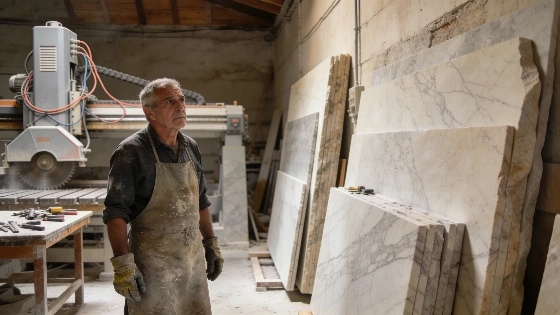
Juan José Martínez, a marble worker with 38 years of experience in Galicia, says orders for marble work remain strong, but the trade faces a critical shortage of young talent and formal training. Without new recruits, the sector risks losing decades of expertise.
At 58, Juan José Martínez still spends his days shaping marble in a workshop in northern Galicia, fulfilling a steady stream of orders for kitchen countertops and funerary art. Despite the unbroken demand, Martínez sees a stark problem: almost no young people are entering the trade, and the future of his profession is at risk.
Martínez, who entered the marble business by taking over a family partnership nearly four decades ago, describes a sector that is busy but aging. “There’s plenty of work,” he says, “but not enough new hands.” The shortage of young workers is so acute that many workshops struggle to find anyone willing to learn the craft, let alone stay for the long haul.
Demand Without Recruits
The marble industry’s predicament mirrors a wider crisis in Spain’s construction-related trades, where a lack of generational renewal is becoming critical. Martínez points out that as construction faces a labor gap, marble workshops—closely tied to the sector—feel the impact just as strongly.
Physical demands remain a barrier. Even as workshops modernize with advanced machinery, the job still involves heavy lifting, working in damp and dusty conditions, and handling large slabs of stone. For many young jobseekers, these realities make the trade less appealing, especially when compared to less physically taxing options.
Compounding the problem is a lack of awareness about the opportunities the marble sector offers. While orders keep coming in, few outside the industry realize that skilled marble workers are in high demand and can build stable careers.
Technology Eases, But Doesn’t Replace
Modern equipment has transformed parts of the marble trade, making cutting and fabrication more efficient. Yet, as Martínez explains, machines still rely on the expertise of the craftsman: “I have to load them, unload them, and tell them what to do.”
Precision tasks—like fitting a countertop or solving installation challenges—require years of hands-on experience. Machines can follow instructions, but only a seasoned marble worker can adapt to the quirks of each project. This blend of technical skill and manual know-how is difficult to pass on without direct, in-person training.
Unlike other trades, there is no formal educational path for aspiring marble workers in Spain. Knowledge is transferred inside the workshop, from veteran to apprentice, but with so few newcomers, this chain is breaking.
Training Gap Deepens the Divide
Martínez believes the absence of a dedicated vocational training program is a major obstacle. “There’s no professional training to bring young people into this sector, and they don’t even know it exists,” he says. Without a clear route into the trade, most never consider marble work as a career. Workshops are left relying on older workers to teach from scratch, but finding willing candidates is harder every year.
“There are no young people ready to learn,” Martínez laments. “I don’t know if it’s because they don’t know about it, or because they prefer to stay at home.” With many experienced marble workers nearing retirement, the risk is that decades of expertise will disappear, leaving the sector unable to meet demand.
This challenge is not unique to marble. Other traditional trades in Spain, such as agriculture, have faced similar dilemmas, as seen when a retired farmer in La Rioja was ordered to repay nearly €47,000 for working while on a pension—a case that highlighted the complex realities of succession and labor shortages in rural sectors (see more on the legal and generational issues in Spanish farming).
For now, the marble industry’s future depends on whether it can attract and train a new generation before the current one hangs up its tools for good.