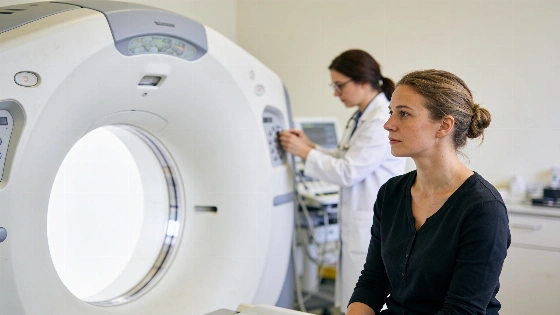
A Universitat de Barcelona study links higher progesterone levels with weaker emotional processing. Women reported lower mood when their brains were less able to separate easier situations from harder ones.
Higher progesterone levels were linked to a weaker ability to distinguish between easier and more difficult emotional situations in a study led by Universitat de Barcelona. The brain patterns looked more alike when progesterone was higher. That weaker separation was associated with lower emotional wellbeing during the menstrual cycle.
Researchers found this difference in the lateral frontal pole, a brain region involved in emotional control. When activity patterns in that area became more similar across contrasting situations, participants appeared less able to tell those situations apart. The study does not describe one specific emotional response. It examines how the brain processes different levels of emotional difficulty.
The study was titled “Endogenous progesterone blurs frontostriatal representations of emotion control in healthy young women” and was conducted by a Universitat de Barcelona team led by Professor Macià Buades.
The findings were published in Psychological Medicine. The team examined natural changes in estradiol and progesterone and compared them with mood and brain activity across the menstrual cycle. The main result concerned progesterone, not estradiol, according to the study and reports on the Universitat de Barcelona research.
The research involved 116 women with natural menstrual cycles. None used hormonal contraceptives. Scientists measured hormone levels in saliva and used neuroimaging while the participants viewed emotional facial expressions. They then applied multivoxel decoding to study the activity patterns. AlphaGalileo reports on the UB/UBneuro study describe this design and method.
Progesterone typically rises after ovulation during the luteal phase and falls before menstruation. This cycle-related timing provides context for why mood and stress responses may change across the month for some women, but it does not by itself establish a clinical effect in every person.
The scans showed less difference between emotionally easier and more difficult situations when progesterone levels were higher. Participants with a clearer distinction between those situations tended to report better mood during the previous week. News-Medical also described the association as specific to progesterone rather than estradiol.
The result adds a specific brain-processing mechanism to a subject often discussed only through mood symptoms. It also fits with medical research into how biological signals may affect emotional wellbeing. Earlier medical research examined the question from another angle.
Estradiol produced no equivalent effect in this study, despite often being associated with better mood and being used to treat menopausal symptoms. The authors caution that the lack of a detected link may reflect the difficulty of measuring estradiol accurately in saliva.
Some medical reviews also discuss progesterone metabolites, including allopregnanolone, in relation to anxiety regulation and the GABA system. That background may help explain why researchers are studying progesterone-related pathways in connection with mood. It does not independently prove the mechanism reported in this study.
The researchers also reject the idea that hormone-related emotional control is exclusively a female issue. Future studies will need to test whether the same relationship exists in men. That question matters because this study examined ovarian hormones in women with natural cycles. It did not establish a universal difference between the sexes.
The study's message is specific: progesterone was associated with less distinct neural responses to different emotional situations and with lower mood indicators. The study does not establish the same pattern for estradiol. It also does not show whether the mechanism applies to men. It does show why menstrual-cycle research needs to examine brain processing alongside hormone levels instead of treating wellbeing as a purely subjective outcome.