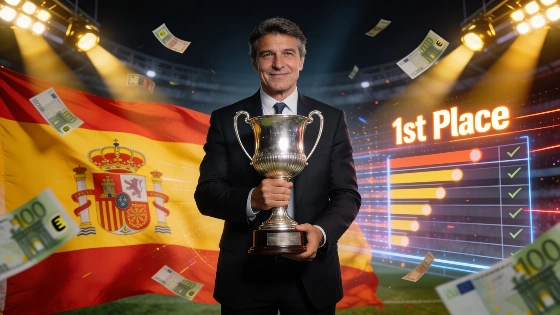
Luis de la Fuente, now the most decorated coach in Spain’s history, earns €2 million annually. His new contract follows Spain’s World Cup victory and places him among the highest-paid national team managers.
Spain’s national football team coach, Luis de la Fuente, has seen his salary reach €2 million per year following the team’s World Cup victory in 2026. Despite leading Spain to global success, De la Fuente’s earnings remain modest compared to the highest-paid coaches at the tournament, a detail that has drawn attention after Spain’s triumph over Argentina in the final.
Before the World Cup, a report from The Mirror highlighted that De la Fuente was only the 15th highest-paid coach among the 48 national team managers participating in the tournament. This ranking placed him well behind figures such as Carlo Ancelotti, who earned €10 million with Brazil but exited in the round of 16, and Julian Nagelsmann, who received €7 million with Germany before being eliminated by Paraguay in the last 32.
De la Fuente’s contract renewal was announced in January 2025, shortly after Spain’s victory at the Euro 2024. His previous agreement with the Royal Spanish Football Federation (RFEF) was set to expire after the World Cup, but the new deal now extends through 2028, covering the next European Championship in the United Kingdom.
With the addition of the World Cup title, De la Fuente has become the most successful coach in the history of the Spanish national team. His record includes a silver medal at Tokyo 2020, a Nations League win in 2023, the Euro 2024 championship, a runner-up finish in the 2025 Nations League, and the 2026 World Cup victory. This achievement has set a new benchmark for Spanish football management.
The salary ranking for national team coaches at the 2026 World Cup, as reported by The Mirror, underscores the disparity in pay. Carlo Ancelotti (Brazil) tops the list with €10 million, followed by Julian Nagelsmann (Germany) at €7 million, and Mauricio Pochettino (USA) at €6 million. Other notable names include Thomas Tuchel (England, €5.8 million), Roberto Martínez (Portugal, €4 million), and Didier Deschamps (France, €3.8 million). De la Fuente’s €2 million places him just behind Lionel Scaloni (Argentina, €2.3 million) and ahead of many other coaches from both established and emerging football nations.
While Spain’s success on the pitch has brought new attention to the financial side of international football, the contrast between salary and results is striking. Several of the highest-paid coaches failed to reach the latter stages of the tournament, while De la Fuente’s comparatively modest contract coincided with historic achievements for Spain. This dynamic has sparked discussion about the value and expectations placed on national team managers, especially in light of recent high-profile exits and contract negotiations across Europe. The debate over coaching salaries and performance is not unique to Spain; similar tensions have surfaced in other sectors, as seen in the ongoing disputes over regional funding highlighted in recent coverage of financial inequalities within Spain.
For context, the role of national team coach in Spain has evolved significantly over the past decade. The position now involves not only tactical leadership but also managing public expectations and navigating complex contract negotiations. The RFEF’s decision to extend De la Fuente’s contract through 2028 reflects both confidence in his leadership and a recognition of the competitive landscape among international coaches. As Spain prepares for future tournaments, the focus will remain on maintaining sporting excellence while balancing the financial realities of top-level football management.