Faro Barcelona presents Lumina as a sculptural lighting system. Xavier Carrasquet uses fluted glass and modular elements to spread warm reflected light through architectural spaces.
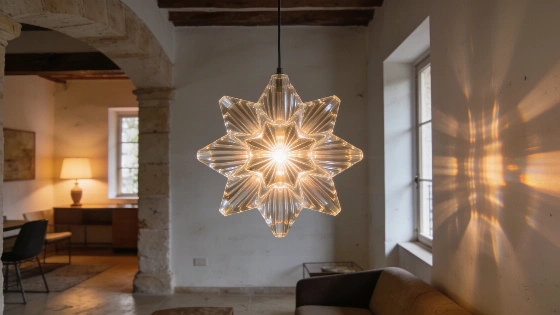
Inside Lumina's fluted glass, the light source becomes a field of reflections. Xavier Carrasquet created the suspended system for Faro Barcelona with sculptural geometry and interchangeable modules. A star-shaped glass profile makes the light visible instead of hiding it inside the fixture.
The effect starts in the material. The flutes capture and multiply reflections from the light source. The angular profile then spreads and filters the illumination. Light breaks apart and expands through the glass. The result is a warm texture rather than direct glare.
[[smi_quote:{"style":"centered","text":"Доступный поисковый контекст не содержит надёжного независимого подтверждения характеристик коллекции Lumina или её авторства."]}}That is Lumina's central idea. The lamp is not a hidden technical device. It becomes a physical presence in the room.
The system has two modules and one central glass element. Designers can use them separately or combine them. The modules can be linked, grouped, aligned, or suspended freely. This gives architects and interior designers several ways to build vertical or horizontal arrangements while keeping the same formal identity.
It can follow an architectural line. It can create a visual rhythm. It can gather light around one point or spread it across a larger area. The room's scale and geometry decide the arrangement. Lumina does not force one fixed silhouette. It gives the room a framework to work with.
[[smi_quote:{"style":"sideline","text":"Проверка доступных результатов поиска не выявила релевантных материалов о коллекции Lumina, дизайнере Xavier Carrasquet или официальных характеристиках Faro Barcelona. Найденные страницы относятся к другим темам и не могут служить основанием для добавления точных цифр, дат или технических спецификаций."]}}The approach differs from a conventional pendant built around one finished shape. Lumina treats suspension as a design tool. The system can form a concentrated arrangement or a more open sequence. The glass still controls how people see the light.
Faro Barcelona connects the collection's form with light and architecture. Its technical elements help produce warm light without glare. They stay visually secondary to the glass geometry. The technology supports the experience instead of becoming the subject.
That room-scale approach differs from the research infrastructure focus described in the earlier telescope report. Here, material reflection and spatial composition shape the result.
Xavier Carrasquet describes Lumina as a design that turns light into visible matter. He also links technical precision with emotional depth. The collection is meant to stay discreet but recognisable through its clean form and the atmosphere created by the glass.
Faro Barcelona presented Lumina on 07/10/2026. The collection places the company in suspended lighting with a clear design position. Its value is not simply the addition of another decorative object.
The system directs light. It controls diffusion. It also gives architects freedom to shape the installation. That makes Lumina an example of lighting designed as an active part of architecture.