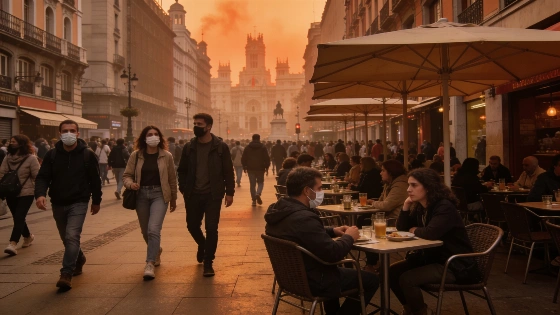
Despite official warnings about hazardous air, Madrid’s city center remained busy. Residents and visitors continued daily routines as smoke from wildfires worsened pollution. Authorities urged caution, but few followed the advice.
Madrid’s city center was packed this Saturday, even as air quality alerts were issued due to smoke from nearby wildfires. From Alonso Martínez to Gran Vía, families, shoppers, and tourists filled the streets, seemingly unaffected by the warnings from both the Ayuntamiento de Madrid and the Ministry of Health. Authorities had advised residents to stay indoors, keep windows closed, and use masks outdoors, especially for vulnerable groups such as children, the elderly, and those with respiratory conditions.
Despite these recommendations, daily life continued with little visible change. Children played in Santa Bárbara square, terraces were full, and traffic moved as usual. Many people appeared unaware of the health risks posed by the elevated levels of PM2.5 and PM10 particles, which municipal sensors recorded as rising sharply since Friday night. The smoke, carried into the city by winds from the Sierra Oeste fires and African air masses, led to deteriorating air quality, particularly in central and southern districts. Early Saturday, stations in Méndez Álvaro, Moratalaz, Ensanche de Vallecas, and Plaza de España reported the highest pollution levels.
Some residents and visitors admitted they had not heard about the warnings. Two women from Alicante, Lourdes Quiles and Brenda de Farias, said they noticed grey clouds but were unaware of the health advisories. Others, like taxi driver Pedro Sánchez, were more informed. He noted that smoke was visible in several areas and some passengers mentioned ash reaching their homes. However, he observed that most people continued their routines, with only a few wearing masks in public. In neighborhoods, he said, many had already left for holidays, and those remaining seemed unconcerned.
Workers on break in Plaza de los Mostenses described a strong smell of smoke in San Fermín earlier that day, but said it did not disrupt daily activities. One mentioned that his family had been evacuated from Navalagamella due to the fires, spending the night at his home before returning. Another noted that ash had settled on cars in Móstoles, yet life carried on as normal. Meanwhile, Teresa Ojando, arriving from Lisbon, described seeing flames from the plane and a strong smell of smoke upon landing, but planned to continue her travels regardless.
By midday, 12 out of 14 municipal air quality stations rated the air as regular or poor. The Ministry of Health, through Mónica García, reiterated the need to avoid outdoor activity and use FFP2/95 masks and protective eyewear if exposed to smoke or ash. She also urged special attention to vulnerable individuals and recommended seeking medical help for respiratory symptoms. Still, many, like Diego Mejía visiting from Barcelona, said they noticed nothing unusual and intended to proceed with their plans, though they were aware of the wildfires and the brownish sky over Madrid on Friday. Argentine tourists in Gran Vía only realized the situation after seeing fire trucks, but had not heard any official advice.
The ongoing wildfires in the region have already led to evacuations and significant concern in affected towns. As reported in coverage of mass evacuations caused by the Madrid wildfires, emergency services continue to battle the flames under challenging conditions. The current episode highlights the gap between official health guidance and public response, as many residents and visitors in Madrid remain largely indifferent to the risks posed by poor air quality.
Air pollution from wildfires can have serious health effects, particularly for those with pre-existing respiratory or cardiovascular conditions. PM2.5 and PM10 particles are known to penetrate deep into the lungs and bloodstream, increasing the risk of respiratory distress and other complications. In recent years, Spain has faced several episodes of poor air quality linked to both local fires and Saharan dust intrusions. Authorities typically issue advisories to limit outdoor activity and recommend protective measures, but public compliance often varies. The situation in Madrid underscores the challenges of communicating health risks during environmental emergencies, especially in large urban centers where daily routines are deeply ingrained.