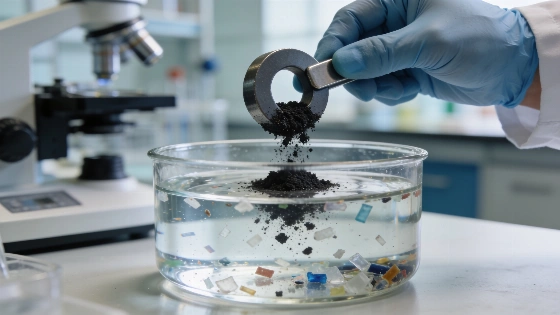
A team at RMIT University has created a reusable magnetic powder that removes over 95% of microplastics, nanoplastics, heavy metals, and pharmaceutical residues from water. The technology works in both fresh and saltwater, offering a scalable solution for water treatment plants.
Researchers at RMIT University in Australia have developed a magnetic powder capable of extracting more than 95% of microplastics, nanoplastics, and a range of other contaminants from water in less than an hour. The material, which can be reused multiple times, targets particles as small as 30 nanometres—far below the threshold of most conventional filtration systems.
Laboratory tests demonstrated that the powder efficiently removed polyethylene, polypropylene, and polyester particles from both freshwater and seawater. Within the first 15 minutes, it captured around 80% of contaminants, aligning with the rapid cycles used in commercial water treatment facilities. The technology also proved effective against heavy metals such as mercury, chromium, and copper, as well as pharmaceutical residues like ibuprofen and industrial dyes.
Addressing a Persistent Challenge
One of the main obstacles in water purification has been the removal of microscopic plastic fragments and other pollutants that slip through standard filters. According to the RMIT team, nanoplastics are particularly problematic because of their ability to bypass traditional barriers and accumulate in living organisms. The new magnetic powder physically binds to these particles, allowing them to be extracted with magnets before they reach rivers, oceans, or municipal supplies.
Initial results also suggest the powder can capture larger molecules from the PFAS group—chemicals known for their persistence in the environment. However, researchers caution that further study is needed to confirm its effectiveness against PFAS in real-world conditions.
Magnetic Recovery and Reuse
Previous absorbent powders often created a new problem: how to remove the cleaning agent itself after use. To solve this, RMIT partnered with Canadian company One Eye Industries to integrate industrial magnets into the process. In trials with wastewater from an industrial laundry—an environment rich in synthetic fibers and chemical residues—the system removed over 88% of polyester microfibers and liquid dyes, even in the presence of soap and organic debris.
After treatment, magnets quickly separated the powder from the water, enabling it to be cleaned and reused. This approach minimizes the risk of secondary pollution and reduces operational costs by extending the powder's lifespan.
Cost and Scalability
The latest version of the powder builds on earlier work by the same team in 2022. By switching to a room-temperature manufacturing process and more affordable raw materials, the researchers increased production fivefold and cut costs by about 75%. The powder's ability to be reused further lowers expenses, making it a practical option for large-scale deployment.
The technology is designed for integration into existing water treatment systems and can tackle multiple types of contaminants in a single process. This versatility is especially valuable for facilities dealing with complex mixtures of textile fibers, pharmaceuticals, metals, and dyes.
Next Steps and Potential Impact
RMIT is now collaborating with Fire and Test Australasia, an Indigenous-owned company in Victoria, to pilot the system in stormwater and community water networks. An agreement with Star Water Group aims to explore applications in the United States and Europe. The researchers believe the powder could benefit textile factories, industrial plants, municipal water systems, and local stormwater collection networks.
Microplastics and nanoplastics are increasingly found in rivers, oceans, drinking water, and food, originating from degraded plastic waste, synthetic clothing, and industrial processes. Their small size makes them difficult to capture with sand, gravel, or basic sedimentation methods. The RMIT solution offers a promising route to intercept these pollutants before they enter the broader environment.
While the technology is still being tested outside the lab, its early results point to a significant advance in the fight against waterborne microplastic pollution. If commercial trials confirm its effectiveness, the magnetic powder could become a key tool for cleaner water worldwide.