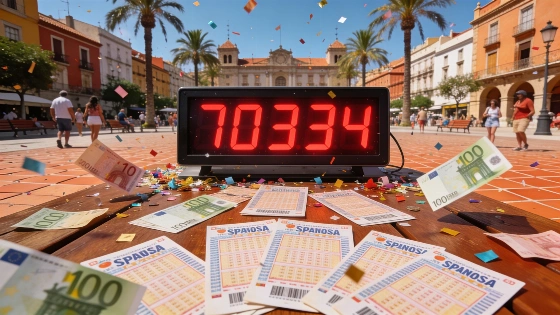
Spain's annual Sorteo Extraordinario de Vacaciones delivered €140 million in prizes. The top award of €20 million went to number 70334. Key winning tickets were sold in Vecindario, Pamplona, Barcelona, Cunit, and Cartagena.
The 2026 Sorteo Extraordinario de Vacaciones, Spain's highly anticipated summer lottery, has distributed €140 million across 36,300 prizes, with the largest single payout of €20 million awarded to ticket number 70334, first fraction, sixth series. According to El Confidencial, this exceptional prize was split between Vecindario (Las Palmas) and Pamplona (Navarra), instantly transforming the fortunes of the lucky holders.
The draw, held on July 4, is a once-a-year event marking the start of summer for many Spaniards. This year, the first prize of €2 million per series also went to number 70334, while the second prize, worth €600,000 per series, was claimed by ticket 61957, sold exclusively in Barcelona and Cunit (Tarragona). Cartagena (Murcia) was the sole location for the third prize, with ticket 45794 securing €200,000 per series.
Beyond the main prizes, the lottery awarded thousands of smaller amounts. Eight three-digit extractions—088, 163, 193, 205, 217, 238, 330, and 489—each brought €1,000 per series. Four two-digit extractions—72, 80, 96, and 99—were worth €400 per series. Reintegros, or refunds, went to tickets ending in 4, 8, or 0, returning €20 per décimo and allowing many participants to recover their stake.
Additional rewards included €8,000 for numbers immediately above and below the first prize (70333 and 70335), and €4,300 for those adjacent to the second prize (61956 and 61958). The lottery also recognized centena and terminación matches, with varying payouts for tickets sharing the last two or three digits with the main winners.
Winners of less than €2,500 can claim their prizes at any authorized lottery retailer, while larger sums require a visit to designated banks such as Abanca, Bankia, BBVA, CaixaBank, and others. All prizes must be claimed within 90 days, starting July 5. Spanish tax law exempts the first €40,000 of lottery winnings, with a 20% tax applied only to amounts above that threshold.
The Lotería Nacional's roots trace back to the reign of Carlos III, who introduced the concept from Italy in the 18th century to boost royal finances. Today, the draw remains a fixture of Spanish culture, with each billete divided into ten décimos, and each décimo uniquely identified by its number, series, and fraction.
For context, last year's draw saw the top prize go to ticket 51376, sold in Elche, Albacete, Motril, and Las Ventas de Retamosa. The second and third prizes were distributed in Cuenca and Guadix, respectively. The annual event continues to attract widespread participation, offering both life-changing sums and smaller windfalls to thousands across the country.
While the lottery dominates headlines each July, Spain's summer calendar is also marked by unique astronomical events. For example, the recent Strawberry Moon, which appeared unusually low in the sky, drew attention from skywatchers nationwide. Details on this rare phenomenon can be found in our coverage of Spain's Strawberry Moon event.
The Sorteo Extraordinario de Vacaciones stands out not only for its massive prize pool but also for its role in Spanish tradition. With thousands of winners and a complex structure of prizes, the draw remains a highlight of the summer, blending anticipation, history, and the hope of a financial boost for the months ahead.