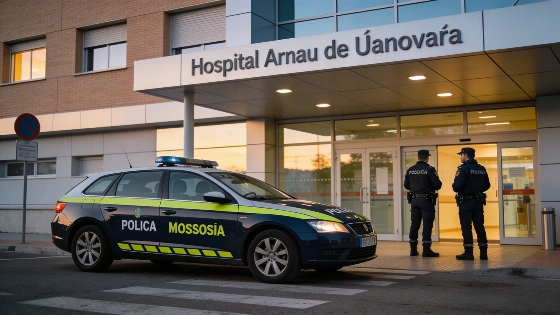
A 42-year-old man was arrested in Segrià after his partner suffered serious injuries in Aitona. The woman remains in intensive care at Hospital Arnau de Vilanova. Authorities activated the gender violence protocol.
Doctors at Hospital Arnau de Vilanova in Lleida are treating a woman with serious injuries after she was assaulted in Aitona early Friday morning. The attack has again drawn attention to the ongoing problem of gender-based violence in Catalonia.
Police say the woman’s life is not in danger, but her condition required an urgent transfer from the local health center in Aitona to the hospital’s intensive care unit. Because her injuries showed clear signs of abuse, medical staff followed the region’s updated protocol for suspected violence against women and notified law enforcement immediately.
По данным официальных сводок, в Каталонии в конце августа — начале сентября 2026 года был зафиксирован очередной случай фемицида, что вызвало широкую общественную и институциональную реакцию.
The Mossos d’Esquadra began searching for the alleged attacker, a 42-year-old man, soon after being alerted by healthcare workers. Officers found and arrested him later that day at a rural property in Torres de Segre, also in the Segrià region. The investigation focused on the victim’s safety and gathering forensic evidence.
This incident comes just weeks after the most recent fatal case of gender violence in Catalonia, when a 34-year-old woman was stabbed to death in Barcelona’s Sant Martí district. That case left two children without their mother and was officially recorded as the fourth femicide in the region for 2026. Each new case has renewed debate about whether current prevention measures are working.
Under the protocol revised last July, Catalan healthcare workers must report any situation where there is a clear risk or evidence of gender-based violence. The goal is to improve early detection and make sure police or prosecutors can step in before more harm occurs. In Aitona, the system was activated as intended and allowed for a rapid response.
Каталонские власти и службы здравоохранения действуют по обновлённому протоколу уведомления о подозрениях на насилие в отношении женщин; в свежих новостях подчёркивается, что в регионе продолжаются меры по усилению раннего выявления и защиты жертв.
The Mossos d’Esquadra have not released more details about the suspect or what led up to the assault. The case highlights the difficulty of protecting vulnerable people in rural areas. The fact that the arrest happened outside Aitona, in another municipality, suggests the suspect tried to avoid being caught—a pattern seen in other recent cases, as noted in a previous investigation.
Even with protocols and legal requirements in place, repeated violent incidents show the limits of institutional safeguards when prevention fails at the personal or community level. The quick response in Aitona may have prevented a fatal outcome, but the broader problem remains: Catalonia continues to face a steady risk of gender-based violence, and each new case points to the need for more effective intervention, support, and accountability.