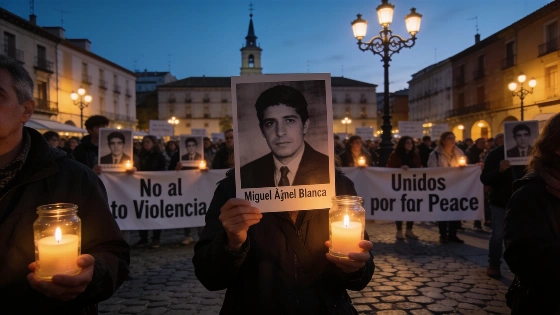
The kidnapping and murder of Miguel Ángel Blanco in Ermua shocked Spain. His death became a catalyst for change in the fight against violence. The memory of those days remains vivid for many across the country.
The abduction and subsequent murder of Miguel Ángel Blanco in Ermua, 25 years ago, stands as a defining moment in Spain’s recent history. The young politician’s fate dominated conversations nationwide, with the sense of urgency and disbelief cutting across regions and generations. In Toledo, as in many other cities, the news of his kidnapping by ETA quickly became the central topic, reflecting the collective anxiety and hope that surrounded the final hours of his life.
Scenes from those days remain etched in the public consciousness: the stunned expression of Blanco’s father as he returned home to find journalists gathered outside, the determination of his sister—who would later lead the foundation bearing his name—and the silent grief of his partner, holding on to the memory of his passion for music. These personal moments underscored the broader impact of the tragedy, which many saw as a catalyst for a shift in Spain’s approach to politically motivated violence.
The murder of Miguel Ángel Blanco is widely regarded as a turning point that signaled the beginning of the end for a period of senseless violence rooted in extremist ideology. The event galvanized public opinion and contributed to a transformation in how Spanish society confronted such threats. The collective response in the aftermath of Blanco’s death demonstrated a new resolve to reject violence and defend democratic values.
Today, the legacy of those days continues to shape Spain’s memory and identity. The story of Miguel Ángel Blanco is not only preserved in personal recollections but also in the country’s broader narrative about resistance to violence. This enduring impact is reflected in ongoing discussions about how younger generations perceive these events. For example, a recent analysis highlighted in a documentary exploring Spain’s memory of ETA reveals that many young Spaniards are unaware of the significance of the Ermua tragedy, raising questions about how such pivotal moments are remembered and taught.
Understanding the context of Miguel Ángel Blanco’s murder is essential for grasping the evolution of Spain’s stance on political violence. The Ermua incident prompted widespread demonstrations and a reevaluation of national unity against terrorism. Over the years, the foundation established in his name has worked to keep his memory alive and to promote values of peace and coexistence. The events of 1997 remain a reference point for discussions about justice, reconciliation, and the importance of collective memory in shaping a democratic society.