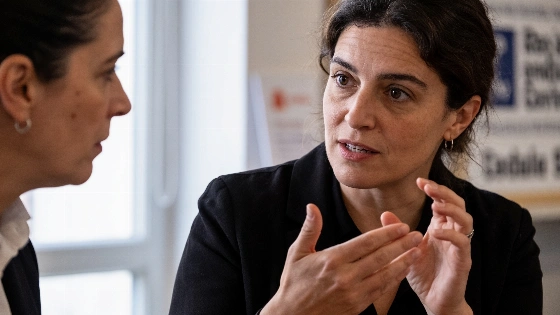
Miriam Garlo won the Goya for best new actress. Her novel revisits years of isolation and the struggle to accept deaf identity, after sign language changed how she understood herself.
At seven, Miriam Garlo lost her hearing after an ear infection treated with aspirin damaged it. She had been born hearing. It took another 23 years for her to learn sign language and recognise deafness as part of her identity. Cadena SER independently confirmed that biographical line.
That change now runs through her work as an actress and writer. Garlo won the Goya for best new actress for Sorda, a film written by her sister Eva Libertad. She has also published Volar con un ala rota with Roca Editorial. The novel uses fiction to examine the physical exhaustion, shame and pressure that shaped her early life.
That cost her.
After the success of Sorda, Garlo has also spoken about the fear of being typecast in cinema and about the everyday barriers faced by deaf people.
For Garlo, sign language became "su agua en mitad del desierto". She speaks clearly and reads lips. An interpreter accompanies her. Signing remains the language in which she feels most at ease. She describes the shift as a move from a world in black and white to one filled with colour.
The novel's central character is Sakia. She shares Garlo's childhood in Murcia, years of study in Madrid, including doctoral research, and the exhausting work of reading lips. Sakia is not meant to be immediately likeable. Anger drives some of her reactions. Other outbursts are harder to justify. Garlo gives her those contradictions instead of turning her into a symbol of suffering.
Sakia's deafness matters, but it does not define the whole book. She is also a woman, heterosexual and an artist dealing with unequal relationships and paternalism. Garlo says the novel grew partly from messages sent by women who were losing their hearing. Some were separated or divorced and had limited financial resources. They felt their families and communities did not understand their changing needs.
The shift was profound.
CNSE says that, 20 years after the adoption of the UN Convention on the Rights of Persons with Disabilities, sign languages must be recognised, protected and developed on equal terms. The confederation also calls for effective implementation of Spain’s Law 27/2007 on sign languages and communication support.
The book also questions the idea that spoken language is automatically more legitimate than visual communication. Garlo examines fonocentrismo, which gives greater authority to voice and sound. She also examines audismo, which places speaking above signing. Her criticism targets a social model that treats deafness mainly as an illness or a deficit. It leaves little room for the value of a linguistic community.
Her account of the years before she found that community is especially severe. Between seven and 30, social pressure and the embarrassment of others kept her from listening to herself. She worked constantly to prove that she was not unintelligent and could reach the same goals as everyone else. Lip-reading left her physically and emotionally drained.
Those years shaped the book.
Garlo does not present Sorda as a documentary. In the film, she plays Ángela, an imaginary character created through affection and understanding. The novel draws on personal experience. Fiction gave Garlo enough distance to write more freely about painful people and events.
Her argument reaches beyond one performer's career. A disability is still too often treated as proof that a person is inferior in every area. The pressure to appear hearing can become a demand to hide, not a path to autonomy. Garlo rejects both roles. She is neither a victim seeking pity nor a symbolic figure stripped of complexity. Her work brings sign language, female independence and artistic responsibility into the same frame. It asks readers to see deafness through respect rather than limitation.
Access to public information is part of that debate. In Huelva, local politician Toti called for sign-language interpretation at all events organised by the provincial Diputación. He said participation in public life begins with the ability to receive and understand information. Huelva Información reported his estimate that between 4,000 and 4,500 people with hearing loss, deaf people and deafblind people live in the province.
The issue is public access.
Garlo's experience shows why communication access cannot depend on individual effort alone. It also cannot depend on a deaf person's ability to adapt to hearing environments. CNSE's position calls for more than cultural respect. It calls for communication support in education, public services and public life. That support must be provided consistently.