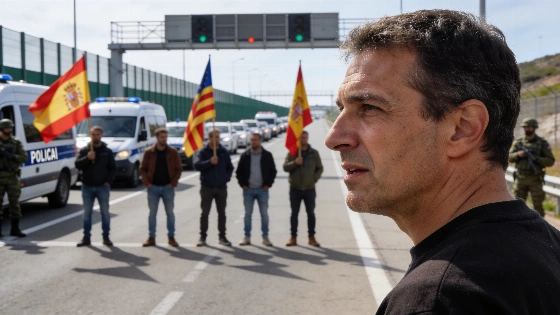
Security forces have reinforced the area around Castillejos before Morocco's vote. Spain's embassy has rejected online claims about automatic entry rights, while Ceuta continues to process hundreds of migrant minors.
Morocco has sharply increased security around the Ceuta border before the legislative elections on Wednesday 23 September. The move follows online messages warning of, or encouraging, a possible new mass crossing on Saturday. Spanish authorities are also dealing with migrant minors in the city and people who arrived during the July crisis. Foreign Minister José Manuel Albares has acknowledged the online calls. He said there were no signs that Morocco was relaxing its border controls because of the election.
Hundreds of uniformed personnel, police vehicles and water tankers are being deployed around Castillejos, according to El País. The border has become a focus in the final days before the vote. The deployment is meant to prevent another irregular movement, not respond to a confirmed new crossing. Reports from El Confidencial and other Spanish media described it as a preventive measure.
Spanish media reports say that at least 3,000 Moroccan security personnel have been deployed around Ceuta as a preventive measure before the election. The presence is not evidence that a new mass assault on the border has already taken place.
Spain's embassy in Rabat has used its X account to challenge what it calls disinformation. It says that entering Spain irregularly through Ceuta or Melilla does not automatically give someone the right to reach the mainland, remain in Spain or move freely across the European Union.
The embassy also referred to a recent Supreme Court ruling on people who arrive by sea. Its explanation is that the ruling sets out a procedure for those cases. It does not change the Immigration Law, declare pushbacks at the border illegal or prevent returns.
The number of minors linked to the Ceuta crisis varies by definition and source. While estimates cited by the Spanish government put the number still living on the streets at 500–700, another report counted 2,048 registered minors; some case files only began being processed in mid-September.
The warning addresses a point that online messages may leave out. Ceuta and Melilla use a two-stage control system. The first check takes place at the border with Morocco. The second comes under Schengen rules when people leave for the mainland by sea or air. Passengers must identify themselves to the Policía Nacional before boarding.
The clarification comes as between 500 and 700 migrant minors are still living on Ceuta's streets, according to Youth and Childhood Minister Sira Rego. In an interview with the SER, she said most wanted to remain in Spain. She said they would be able to do so because Spanish law protects them, particularly children fleeing severe violence. Reports in Ara and El Constitucional also describe the authorities' continuing work to register and process their cases.
Rego said the first family reunification files should be ready within days. Morocco's response will be decisive for those applications. The minister said Spain had already processed 600 cases without receiving an answer. She called the lack of a regular response from Moroccan authorities a difficulty in carrying out reunifications. Morocco has publicly rejected responsibility for the situation involving minors in Ceuta. That has added to the political tension over their transfer and protection.
Interior Minister Fernando Grande-Marlaska is travelling to Ceuta to inspect the Centro de Atención Temporal de Extranjeros (CATE). Arrivals from late July are being assessed there for asylum procedures or expulsion. He is also due to visit Policía Nacional and Guardia Civil units, as well as the Oficina de Asilo y Refugio facilities opened in the autonomous city.
This will be his fourth visit since the mass arrivals of 30 and 31 July. Thousands of migrants are still sleeping on beaches or staying on the streets. The crisis has also sharpened the political dispute between the central government and the administration led by Juan Jesús Vivas and the PP. An earlier account detailed another dispute over how the government handled warnings linked to the border surge.
Security concerns also emerged at the port. Several dozen people gathered after members of the collective 'Negu Gorriak/Derecho a Techo' arrived. The group says it wants to provide humanitarian assistance and observe possible attacks against refugees after the July entry. At least one person was held in a police vehicle. Stones were thrown at at least one vehicle that left under police escort.
On Friday, 1,700 migrants were moved from a beach to Ceuta's port. Reports by Brussels Times and Spain English said Spain had begun transferring people to a new shelter near the port. Capacity was still under pressure. Some migrants later returned to the beaches after reception facilities filled.
The reinforced Moroccan presence, the embassy's warning, the unresolved situation of minors and the Interior Ministry's response are all unfolding at the same time. For anyone considering an irregular crossing, the main point is clear: arriving in Ceuta does not provide the automatic rights described in online messages. Controls and procedures continue after the border itself.