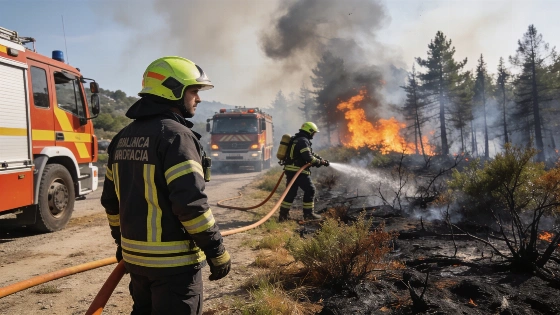
The wildfire in Niebla remains uncontrolled, with more than 20,000 hectares within its perimeter. Over 500 residents have been evacuated as emergency teams struggle to contain the flames.
The wildfire in Niebla has escalated into one of the most severe emergencies in recent years, with authorities confirming that the blaze is now beyond current extinction capabilities. More than 20,000 hectares are within the fire's perimeter, and over 500 people have been evacuated from their homes in Huelva and Sevilla provinces as a precaution. The situation remains critical, with the fire advancing rapidly and emergency services facing significant operational challenges.
On Monday, the evacuation of the villages Las Delgadas and Sorromero in Zalamea la Real was ordered, adding to the growing number of displaced residents. The main settlement of El Madroño and its four outlying hamlets—El Álamo, Juan Antón, Juan Gallego, and Villargordo—were also cleared. Evacuees are being transported to the Teatro Municipal Ruiz Tatay in Zalamea la Real, which has been prepared to accommodate both new arrivals and those already displaced. The evacuation route covers approximately 14 kilometers, utilizing the HU-6104, A-476, and N-435 roads.
Antonio Sanz, Vice President and Minister of Presidency, Health and Emergencies, reported from the Advanced Command Post that the fire's behavior is unpredictable and dangerous. The affected area consists mainly of eucalyptus, dehesa, and pine forests. According to the Junta de Andalucía, the 20,000-hectare figure refers to the area inside the fire's perimeter, not the total burned surface. Sanz highlighted that meteorological conditions have offered no relief, and emergency teams are contending with hazardous convection phenomena that generate secondary fires kilometers away from the main front. In some cases, aerial units have had to airlift isolated ground teams surrounded by flames, as the intense convection prevents water drops from reaching the ground effectively.
Complicating matters further, strong southwesterly winds began pushing the fire northeastward early Monday, accelerating the spread and limiting the effectiveness of firefighting efforts. Sanz emphasized that the scale and behavior of the fire, rather than a lack of resources, are the main obstacles to containment. The risk of new secondary outbreaks and the reduced impact of aerial operations continue to threaten both the landscape and the safety of emergency personnel.
Despite these setbacks, some progress was made overnight. Controlled burns were carried out in the northern sector, and mechanized firebreaks were established in the northeast, using already burned areas as support. Additional burns were conducted south of Berrocal to reinforce defensive lines. The main objective for Monday is to contain the northern flank and the fire's head, focusing efforts between El Pozuelo, Marigenta, and Berrocal with heavy machinery, ground teams, and further controlled burns. In the southeast, bulldozers and ground crews are working along the black perimeter line toward the northeast. A secondary contingency line has also been set up between Aznalcóllar and Berrocal in case the fire breaches the initial defenses.
Currently, more than 600 personnel are deployed, supported by 26 aircraft. Resources include 15 specialist firefighter groups, 11 fire engines, 10 heavy machines, and 250 members of the Military Emergency Unit with three additional machines. The goal is to reduce the fire's intensity and limit its spread, but the region's terrain and shifting winds continue to complicate operations. Authorities warn that stabilization is not expected soon, with several days of intense work likely ahead. Sanz described the situation as a prolonged and obstacle-filled struggle, with no immediate improvement in weather conditions.
Further evacuations remain possible, with the hamlet of La Delgada in Zalamea la Real and Madroño in Sevilla on alert. Acting Government Delegate in Andalucía, Francisco Toscano, noted that today's weather is unfavorable for firefighting. He stressed that difficult decisions have been and will continue to be made as the crisis unfolds.
Wildfires have become an increasing concern across Spain, with similar mass evacuations recently reported in other regions. For example, urgent relocations were necessary in Segovia and Castellón as fires reached critical levels, highlighting the growing challenge of managing large-scale blazes under adverse conditions. More details on those incidents can be found in this report on evacuations in Segovia and Castellón.
Spain's wildfire season has lengthened in recent years, with climate factors and land management practices contributing to more frequent and intense incidents. The Niebla fire underscores the need for coordinated emergency response and ongoing investment in prevention and rapid intervention capabilities. As the situation develops, local authorities continue to prioritize resident safety and the protection of critical infrastructure.