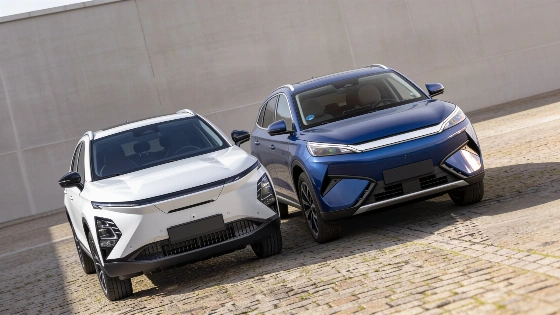
The Omoda 5 EV and BYD Atto 3 EVO offer sharply different takes on the electric SUV. One is affordable and city-focused, the other more advanced and versatile. We compare their specs, features and value to help you decide.
Choosing between the Omoda 5 EV and the BYD Atto 3 EVO means weighing two distinct approaches to the electric SUV. Both models come from Chinese manufacturers, but their priorities and strengths diverge sharply—one aims for affordability and urban use, the other for greater range, space and technology.
Design and Dimensions
The Omoda 5 EV, the first electric model from Chery's Omoda brand in Spain, measures 4.42 meters long, 1.83 meters wide and 1.59 meters high, with a 2.63-meter wheelbase. Its coupe-inspired silhouette stands out visually, but this comes at the cost of rear headroom—adults over 1.85 meters will find their heads brushing the roof. Rear access is comfortable, but the middle seat in the back row is narrow and less usable. The trunk offers 380 liters, which is modest for a compact SUV.
In contrast, the BYD Atto 3 EVO is slightly larger at 4.45 meters long, 1.87 meters wide and 1.61 meters high, with a 2.72-meter wheelbase. The interior is more spacious, especially in terms of headroom, and the trunk is significantly bigger at 490 liters (expandable to 1,360 liters with the rear seats folded). There's also a 95-liter front trunk, making the BYD much more practical for families or longer trips.
Cabin and Technology
Inside, the Omoda 5 EV features a clean dashboard design with two 12.3-inch digital screens—one for instruments, one for infotainment—joined in a single panel. While the layout is modern, the touchscreen's responsiveness and menu logic can frustrate, with sluggish performance and unintuitive navigation. Materials and build quality are solid for the price point.
The BYD Atto 3 EVO, recently updated, improves on its predecessor with higher-quality materials in key areas and a minimalist dashboard. It features an 8.8-inch digital instrument cluster and a large 15.6-inch rotating touchscreen for multimedia, plus a new steering wheel and more standard equipment, including a head-up display. The gear selector has been moved to the steering column, freeing up space in the center console.
Performance and Range
The Omoda 5 EV is offered in a single configuration: a 204 hp electric motor paired with a 61 kWh LFP battery, delivering a WLTP range of up to 430 kilometers. Charging is possible at up to 11 kW AC and 80 kW DC, with a 10-80% charge taking about 28 minutes. The battery technology is robust, but the system voltage is 375V, limiting fast-charging potential compared to newer rivals.
The BYD Atto 3 EVO comes in two versions: rear-wheel drive with 313 hp, and all-wheel drive with 449 hp. Both use BYD's signature 74.8 kWh Blade Battery, offering 510 km and 470 km of WLTP range, respectively. The 800V architecture allows for DC charging up to 220 kW, slashing 10-80% charging time to just 25 minutes. AC charging is also capped at 11 kW. This technical edge gives the BYD a clear advantage for those planning longer journeys or frequent fast-charging stops.
Equipment and Pricing
The Omoda 5 EV starts at €22,890 (including government incentives and promotional discounts), making it one of the most affordable electric SUVs in Spain. Standard features include 18-inch alloy wheels, adaptive cruise control, dual-zone climate, wireless charging, heated steering wheel, full LED lighting, keyless entry and start, and a suite of driver assistance systems. Two trim levels—Comfort and Premium—are available.
The BYD Atto 3 EVO is priced from €42,990, but current promotions and incentives bring the effective starting price down to €31,987. Standard equipment is generous, with electric, heated and ventilated front seats, four-way lumbar adjustment for the driver, a 360-degree camera, powered tailgate, and a heat pump. Two trims—Design and Excellence—cover the range.
Which to Choose?
The Omoda 5 EV is a compelling option for buyers focused on city driving, value and a strong equipment list at a low price. Its limitations in space and range are offset by its affordability and modern features. The BYD Atto 3 EVO, meanwhile, is the more complete package: it offers more space, greater practicality, superior technology and longer range, but at a higher cost. For those who need a family car or plan to travel longer distances, the BYD is the clear winner.
For drivers comparing the Omoda 5 EV and BYD Atto 3 EVO, it's worth noting how the market for compact electric SUVs is evolving. Models like the Kia EV2 GT-Line, recently reviewed in detail at RUSSPAIN, show that competition is intensifying, with each brand targeting a specific balance of price, range and features.
Context and Outlook
Both Omoda and BYD are part of a new wave of Chinese brands making rapid inroads into the Spanish and European EV markets. Their aggressive pricing and fast product cycles are reshaping consumer expectations. As charging infrastructure improves and battery technology advances, the gap between affordable and premium electric SUVs is likely to narrow further. For now, the choice between the Omoda 5 EV and BYD Atto 3 EVO comes down to budget, daily needs and how much value you place on space, range and advanced features.