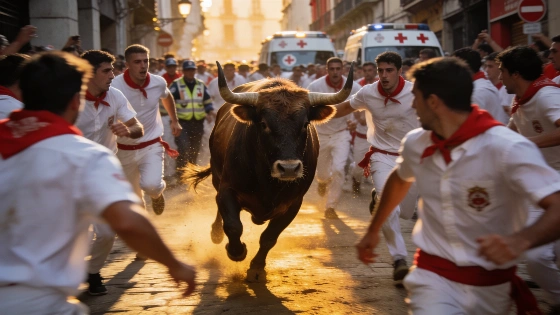
A lone bull from La Palmosilla left one runner gored and eight others injured during the sixth San Fermín encierro. The incident occurred near the plaza entrance amid heavy weekend crowds. Medical teams responded quickly.
The sixth running of the bulls at San Fermín 2026 turned tense on Sunday morning as a solitary La Palmosilla bull charged into a group of runners near the entrance to Pamplona’s bullring, resulting in one person suffering a goring to the elbow and eight others sustaining contusions. The incident unfolded in the crowded alleyway just before the plaza, where the bull, separated from the herd, swept along the left-side barriers and collided with several participants. Emergency medical staff treated the gored runner in the bullring’s infirmary, while others were attended for injuries to the head, face, legs, feet, and shoulders.
This year’s encierro, featuring the Cádiz-based La Palmosilla bulls for the sixth time, was marked by both the animals’ speed and their generally calm behavior. Despite the high number of runners—typical for a weekend event—the bulls completed the 845-meter course in just two minutes and 23 seconds, nearly a minute faster than last year. Organizers noted that the natural temperament of the La Palmosilla bulls likely prevented a higher injury count, even as the density of runners increased the risk of falls and collisions, especially along Estafeta Street.
While the first half of the run offered more space for both bulls and runners, the situation quickly deteriorated as the herd fragmented midway through Estafeta. The number of participants surged, leading to more frequent falls and minor pile-ups on the cobblestones. Two reddish bulls led the group through the Telefónica section, while others became scattered, weaving through tightly packed runners on both sides of the route. The cabestros, particularly the largest among them, played a key role in guiding the herd, but the pack broke apart as one bull surged ahead at Mercaderes, taking the lead into the Estafeta curve and triggering a series of stumbles and trampling incidents.
By the time the bulls reached the final stretch, the herd was fully dispersed. Two bulls, accompanied by a pair of cabestros, entered the bullring first. Another bull swept the right-side barriers, knocking down several runners, while the bull responsible for the goring moved along the left. The last to enter the arena were a reddish bull and three lagging cabestros. Despite the chaos, the total time of two minutes and 23 seconds was considered remarkable given the obstacles faced in the latter half of the course.
The bulls set to appear in the afternoon’s corrida are Cortijero (575 kg), Jubiloso (580 kg), Zorzal (565 kg), Sombrerito (575 kg), Cantarillo (555 kg), and Mirlo Blando (585 kg). The matadors for the event are Fortes, Fernando Adrián, and Samuel Navalón. The medical report also confirmed that three runners injured in previous encierros remain hospitalized. Among them is a 30-year-old from Alicante, currently in intensive care after suffering a serious goring and jaw fractures on Mercaderes Street. Another, a 65-year-old from Castro del Río (Córdoba), is being treated for bilateral pneumothorax following a traumatic injury on Friday, while a 63-year-old from Zizur Mayor is recovering from a fractured left hip sustained during a fall on Santo Domingo.
This year’s San Fermín festival has seen a series of high-speed, high-risk runs, with medical teams on constant alert. The combination of experienced bulls and dense crowds continues to test both runners and organizers. For context, a previous run with La Palmosilla bulls also resulted in multiple injuries and highlighted ongoing safety concerns, as detailed in this recent report on another fast San Fermín encierro.
San Fermín’s encierros are among Spain’s most iconic and closely watched events, drawing thousands of participants and spectators each July. The festival’s blend of tradition, adrenaline, and risk has made it a focal point for both local authorities and emergency services, who prepare extensively for each run. The medical infrastructure in Pamplona is specifically reinforced during the festival, with additional staff and resources allocated to handle the predictable surge in injuries. While the majority of incidents involve minor contusions or sprains, gorings and fractures remain a persistent hazard, especially when bulls become separated from the herd. The ongoing challenge for organizers is to balance the festival’s historic appeal with evolving safety protocols, particularly as crowd sizes fluctuate on weekends and public holidays.