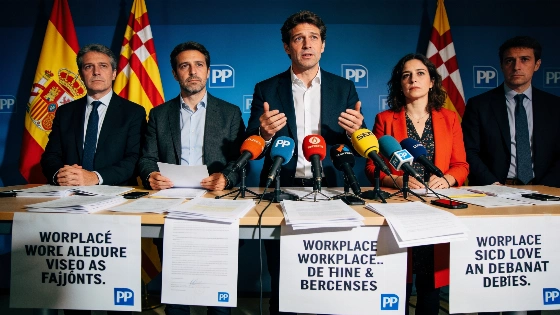
The Partido Popular has clarified that Feijóo’s recent statements on sick leave targeted fraudulent cases, not genuine illness. The party now stresses the need for consensus on tackling absenteeism and rejects pay cuts for the sick.
The Partido Popular (PP) has moved quickly to clarify comments made by its leader, Alberto Núñez Feijóo, after his recent statements on sick leave payments triggered a political storm. Feijóo had described the rise in workplace absences as a “cancer” and questioned whether employees should receive full pay while not working. The backlash was immediate, prompting the party to specify that his criticism was aimed solely at fraudulent sick leave, not at workers genuinely suffering from illness.
Juan Bravo, the PP’s deputy secretary for finance, addressed the controversy on Tuesday, acknowledging that Feijóo’s words may have been misinterpreted. Bravo insisted that the party does not support reducing pay for employees who are legitimately ill. He emphasized that Feijóo’s intention was to highlight the problem of fraudulent absences, not to penalize those facing serious health issues. “No one in the PP wants cancer patients or the genuinely ill to receive less,” Bravo stated during an interview on La Sexta, underlining the party’s position on protecting vulnerable workers.
Feijóo’s original remarks, delivered at a business event in Bilbao, questioned the logic of company agreements that allow employees to earn the same salary whether present or absent. He also criticized public administration practices that, in his view, enable unjustified absences without financial consequence. Feijóo argued that the current system of absenteeism is unsustainable and called for a reform of sick leave regulations, even suggesting that changes might proceed “with or without” agreement from unions and employers.
However, the PP leadership has since softened this stance, now insisting that any changes to sick leave rules will only be made through social dialogue and consensus. Bravo stressed that the party’s goal is to address the financial burden of absenteeism, which he said has grown significantly for both public finances and private companies. He cited figures showing that the cost of sick leave has more than doubled in recent years, reaching €33 billion—an amount comparable to the entire budget of the Community of Madrid. According to Bravo, half of all sick leave is concentrated among just 10% of workers, and Mondays see a spike in absences, with 1.7 million people off work, double the number on Fridays.
The PP maintains that the system is not functioning as intended and points to the government’s own creation of a working group to address the issue. The party supports reducing pay only in cases of proven fraudulent absence, not for those who are genuinely ill. Bravo reiterated that the party’s priority is to ensure maximum protection for sick workers while tackling abuse of the system. The leadership also defended Feijóo’s decision to raise the issue publicly, arguing that clear and direct debate is needed on absenteeism in Spain.
Debates over workplace conditions and absenteeism are not new in Spain. In a related development, a court in the Canary Islands recently ordered Social Security to compensate a civil servant for stress caused by understaffing, highlighting ongoing challenges in managing workplace risks and absences. Details of that case can be found in this report on compensation for staff stress in La Palma.
Spain’s sick leave system is governed by both national law and collective bargaining agreements, which often guarantee full or near-full pay during medical absences. The debate over absenteeism has intensified as costs have risen, with employers and policymakers seeking ways to balance worker protection with the need to prevent abuse. The PP’s latest clarification signals a willingness to engage in dialogue, but also underscores the political sensitivity of any proposed changes to sick leave rules. As the discussion continues, the focus remains on finding solutions that protect both public resources and the rights of workers facing genuine illness.