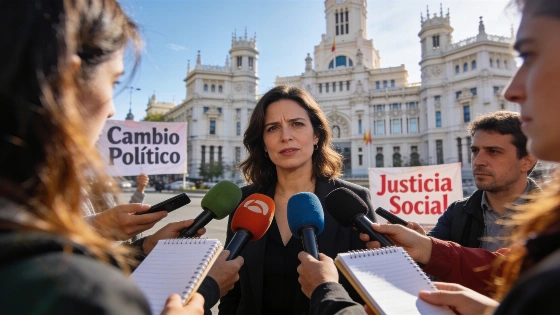
Rita Maestre, Más Madrid’s mayoral candidate, highlights rising hostility against women in politics and the challenges of breaking entrenched power in Madrid. She urges vigilance without falling into conspiracy thinking.
Rita Maestre, recently confirmed as Más Madrid’s candidate for mayor, has drawn attention to the intensifying climate of hostility facing women in Spanish politics, particularly those on the left. After more than a decade in public life, Maestre describes a political environment in Madrid where entrenched power structures and digital aggression have become increasingly normalized, especially since the rise of polarizing figures and the spread of hate speech on major social networks.
Maestre points to a pattern that began in 2015, when new political forces entered city governments and the traditional right responded with what she calls a highly polarized and reactive stance. She notes that this shift led to a narrative dividing governments into “legitimate” and “illegitimate,” with the latter facing persistent judicial and media pressure. According to Maestre, this environment has only grown more hostile, with women and feminists often bearing the brunt of both online and offline attacks.
Despite these challenges, Maestre says Más Madrid has focused on grassroots campaigning, reaching out directly to residents in a city where media visibility is dominated by figures like Isabel Díaz Ayuso and José Luis Martínez Almeida. She argues that long-term control by a single party in Madrid has created a complex web of economic, judicial, and media interests that is difficult to dismantle, leading to a normalization of everyday problems and a sense of resignation among citizens.
Maestre is critical of recent city decisions, such as the failed Bernabéu parking project, which she claims wasted public funds and served only a minority interest. She also highlights the influence of powerful business figures, referencing Florentino Pérez’s public statements as emblematic of unchecked power in Madrid. In her view, these examples illustrate how public resources and decision-making can be skewed away from the broader public good.
On the subject of ongoing judicial cases, including those involving Alberto González Amador, Maestre stresses the need for transparency and warns against both conspiracy theories and naïveté. She describes a pattern of legal actions—often referred to as lawfare—targeting left-wing politicians, with cases frequently ending without convictions but still serving to disrupt political activity. She points to the lengthy Púnica case as evidence of how justice can move slowly for some, while other cases are expedited.
Maestre also addresses the legacy of previous Socialist leaders, noting that her political generation emerged in opposition to the PSOE-PP agreement to prioritize debt over social services in the Constitution. While acknowledging positive achievements by José Luis Rodríguez Zapatero, she argues that the culture of revolving doors and political-business ties predates his tenure and calls for equal scrutiny of all former leaders’ business activities.
Discussing the current political landscape, Maestre expresses concern about the possibility of far-right figures like José María Figaredo or Santiago Abascal gaining key ministerial roles. She insists that the left must present itself as a clean alternative, especially as corruption cases involving the PSOE are being processed more swiftly than those linked to the PP. In this context, she praises Yolanda Díaz’s leadership and the role she played in the 2023 coalition, while acknowledging the need for a more deliberate approach in selecting future leaders for Sumar, with a decision expected in September.
Maestre emphasizes that Más Madrid maintains internal democracy through primaries and district assemblies, despite recent resignations from the Committee of Guarantees over updated internal protocols. She views such departures as a normal part of organizational life when disagreements arise.
Reflecting on her own future, Maestre believes that building lasting political leadership in a city of 3.5 million requires time and continuity, rather than frequent changes in party spokespeople. She notes that her recognition among residents is the result of sustained street-level work.
In 2024, Maestre publicly addressed the impact of learning about the conduct of her former partner, Iñigo Errejón, who resigned as spokesperson following an anonymous complaint. She states that while not all allegations can be proven in court, ethical standards require immediate action in such cases. Más Madrid has since updated its anti-harassment protocols to better handle complaints, including those from outside the organization, aiming to prevent future ambiguities.
On the handling of anonymous complaints, Maestre acknowledges the complexity of the issue. While ideally such matters would be resolved in court, she recognizes that many victims of sexual violence find it difficult to come forward through official channels. She believes organizations must investigate all credible reports, even if anonymous, but cautions against assuming all such claims are automatically true. The challenge, she says, lies in the broader system’s shortcomings, not in the actions of women who speak out.
Maestre’s concerns about entrenched power and the slow pace of judicial proceedings echo broader debates in Spanish politics. For example, recent discussions about regional funding and inequality, such as those raised by Castilla-La Mancha’s leader, highlight how institutional inertia can shape both local and national outcomes. These issues are explored further in reports like this analysis of Spain’s regional funding model, which underscores the challenges of reforming established systems.
In summary, Maestre’s campaign centers on breaking cycles of normalization and resignation in Madrid’s political life, advocating for transparency, ethical standards, and a more inclusive approach to leadership. Her experience reflects the broader tensions facing Spain’s left as it navigates entrenched interests, legal battles, and the evolving demands of its electorate.